
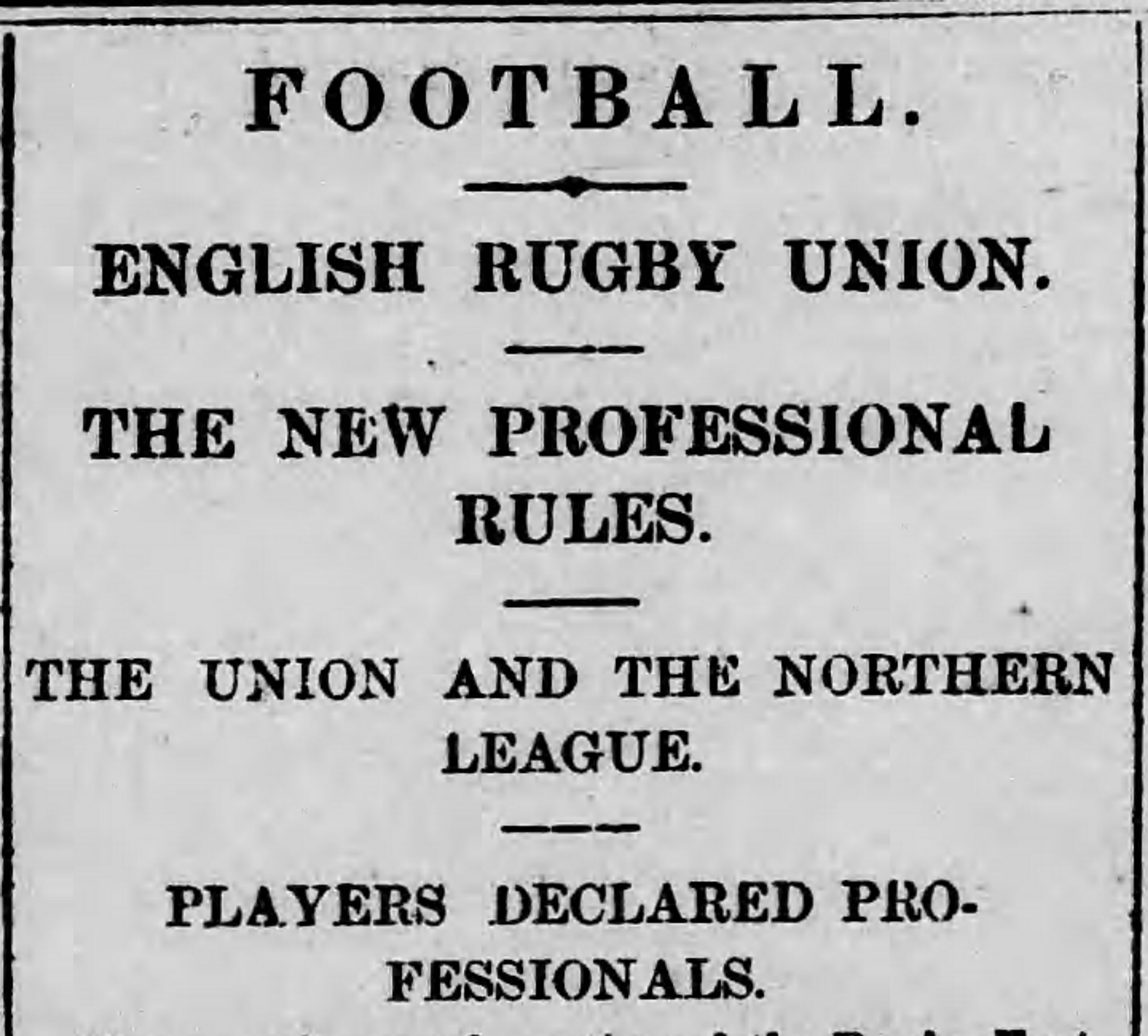
In 1895, class, geography, and politics split a footballing code in half. Over a century later, the war still wages between the two codes. But what does Andy Burnham have to do with it all?
Thank you for reading! The Rugby History Project is able to keep going thanks to the support of the readers (aka you!). If you’d like to upgrade to a paid subscription, or if you’d like to leave a one-time tip, please click here.
Despite their shared origins, in England, rugby union and rugby league have vastly different stereotypes. Whilst rugby union is seen as the game for public school boys and farmers, rugby league is seen as inherently Northern and working class. Whilst many union fans bristle at the stereotype, league fans are often more than happy to perpetuate it. Whilst the class implications of rugby union were covered in the November 2025 article Why is Rugby Union Posh?, today we will be looking at the class implications of rugby league in England, and why we even have two rugby codes in the first place.
Rugby rules football began spreading throughout England in the mid-nineteenth century. Originally confined to the nation’s public schools, it didn’t take long for the game to spread far beyond the reaches of schoolboys. The first non-school related game1 took place in Liverpool in December 18572, at the aptly titled Liverpool Football Club3 based at the Edge Hill Cricket Oval. The participants were firmly middle class, having learned the game at various public schools across England. Northern businessmen and professionals from similar backgrounds began setting up clubs across the North of England, with a strong concentration of clubs in Lancashire and Yorkshire. Just like in London and the South, rugby clubs were a way for middle-class men to network and to exercise, a key component of the principle of muscular Christianity.

The second key component of muscular Christianity is, rather obviously, Christianity4, with the principle being closely linked to the Church of England and Anglicanism5 in Britain during the nineteenth century6. Muscular Christianity as a concept is, at its essence, the exercise of both the body and the spiritual mind, with the end goal being a physically fit body and a devout Christian mind. Proponents of muscular Christianity understood that the belief system would lead to a class of young men who were both physically and mentally disciplined, making them ready to lead in both private and public life. The ideals came as a result of a growing public perception that men were declining in manliness as the virtues of love and gentility were popularised7. Physical brutality at Britain’s public schools filled much of this void, and the adoption of local folk football codes gave the students a perfect ‘civilised’ outlet for the physicality.
Church officials were key proponents of muscular Christianity, even if they disliked the term itself. Church sporting clubs, and specifically rugby sides, were exceptionally common in the late nineteenth century. Whilst some were set up for local middle-class businessmen and professionals, in the same vein as Old Boy clubs, others were founded by the clergy for the benefit of the parish. Anglican clergy during the nineteenth century were of the same social class as businessmen and professionals, many having played rugby football at the same public schools. Unlike their secular counterparts, the aim was not for their own physical wellbeing. The aim of clergy- supported teams was to enable their middle-class parishioners to participate in the principle of muscular Christianity; introduce the principle itself to the working-class and allow them to have a physical outlet; and bring in new parishioners who were attracted by the sporting offering. Church-based clubs were not unusual across the country, and many remain today, with modern powerhouse union club Northampton Saints founded in 1880 by St James’ Church leader Rev. Samuel Wathen Wigg under the name Northampton St James8. Another club founded by the clergy under the auspices of spreading the gospel and benefiting the working class was Leeds Parish Church F.C. in 18749.

Leeds Parish Church F.C. is an extremely interesting case study in regard to the changes in Northern rugby during the late nineteenth century. They were known for being a well-supported club in terms of the sheer number of supporters, as well as their dedication to following the club. However, due to the club’s location in the north of Leeds, they did not draw on traditional rugby crowds. Whilst the church had specifically wanted a non-traditional supporter base upon the teachings of muscular Christianity, they did expect the supporters to engage in a specific way. Rather than using matchdays as a form of networking and exercise, the supporters, who were primarily of working-class and immigrant backgrounds, used matchdays as a form of entertainment involving alcohol and lividity. The club copped a month-long ban following a crowd attack on a referee in 1890, and whilst on tour to Ireland in 1891, several supporters were arrested following rowdy behaviour10. The team had initially been seen as ‘the embodiment of the sane doctrine of Muscular Christianity’11, but by the turn of the century the club could no longer be described in that way. Whilst the church struggled with the club’s violent image, they also were at odds with a large segment of their support base. The north side of Leeds was home to the city’s Jewish community, and many of them supported the Parish. It was clear to the church that the evangelising aspect of rugby was not working, and therefore in 1901 the club abruptly closed12.

Whilst the religious dilemma of Leeds Parish is somewhat unique, the situation they found themselves in regarding their supporters’ view of rugby is not. Whilst the organisers of the game in the North continued to be of public school stock, players and supporters were far more mixed. Lower middle-class businessmen13 rubbed shoulders with working-class men, women and children at games. For small towns in Yorkshire and Lancashire, games at the local rugby club became the focal point of town life, becoming a community gathering place and a form of entertainment. Whilst those who attended games in other parts of the country were often called spectators, those in the industrial North were more commonly referred to as supporters. Whilst this is a small change in terminology, it also reflects that those watching were biased toward one team. Northern supporters paid a small fee to attend games, and season tickets were carefully managed by clubs to prevent overcrowding. Off the pitch, rugby in the North was a mass spectator sport which often made a profit, and on the pitch it was innovative.
Northern players became a core part of the English national team in the mid-1880s, and by 1892 eleven of the starting fifteen were manual labourers from the North14. Northern players were known for being skilled and exceptionally fit15. They were also willing to take risks and change the way the game was played, with the first recorded passes from a halfback to a centre being recorded in 1881 by Lancashire players J. H. Payne and Teddy Bartram, and the first pass from a centre to a winger being recorded in 1886 by Bradford player Rawson Robertshaw16. Additional changes such as scrum formation, including placing wing-forwards on the flank of the scrum and having three front row players, and dictating where forwards should be on the pitch during open play, were all Northern inventions. Whilst rugby’s Southern overlords slowly accepted the innovations, the inclusion of working-class players came with uniquely British issues. Whilst former public school boys praised themselves for their ability to be hacked to pieces, they often complained of roughness from working-class players from the North.

The biggest issue that separated the two worlds was the idea of financial gain from playing rugby. Train tickets for away days were seen as an acceptable item to be reimbursed for or provided, as were large quantities of alcohol, but any other form of reimbursement was frowned upon by the RFU. The issue of players receiving payment became an issue for Northern rugby in the late 1870s, with Wakefield Trinity’s Teddy Bartram being the first confirmed player to be paid17. Bartram was a cricket professional who had been recruited to play for York whilst living in Harrogate; unfortunately for Bartram, he could not afford the travel costs for training nor home games. After returning to Harrogate, he was recruited to Wakefield Trinity, who offered to pay for his travel. Whilst train tickets for away games were often considered an acceptable cost for clubs to cover, Bartram’s travel to his home club seemed to be an expected cost for a rugby player to cover himself, and therefore being compensated for it was a sign of professionalism. Wakefield would go on to name Bartram the assistant secretary of the club complete with a stipend, although he is not believed to have actually carried out any off-pitch duties. Despite his success on the pitch, Bartram was never selected to play for England, as Southern selectors disapproved of his payment.
‘That no gentleman18 ought to make a profit by his services in the cricket field, and that for the future, no cricketer who takes more than his expenses in any match shall be qualified to play for the Gentleman versus Players at Lords; but that if any gentlemen feel difficulty in joining in the match without pecuniary assistance he shall not be barred from playing as a gentleman by having his actual expenses defrayed.’
-The MCC definition of an amateur sportsman which was used as the basis for the Yorkshire Boards definition of amateur.19
With no laws on professionalism in the RFU lawbook, the Yorkshire Board decided to enact their own laws based on the Marylebone Cricket Club rules on amateurism. The MCC rules on amateurism were rooted in classism and aimed to exclude working-class players from competition. Gentlemen cricketers were seen as the pinnacle of the sport; they were middle- and upper-class men who could afford to play for leisure. On the other hand, professional cricketers were working-class players who were paid expenses and small sums to play on cricket tours. The exclusion of working-class players in sports such as athletics was not uncommon, but banning working-class players from rugby based on class alone was virtually impossible due to their sheer volume. Instead, banning professional players, all of whom were working class, from important games such as the Challenge Cup matches was seen as the solution to stopping professionalism by middle-class board members who ran the game. However, the definition of professional was exceptionally broad and even had a provision for those who would be put out of pocket or unable to play if assistance was not given. As such, professionalism, as it was defined, continued in earnest across Yorkshire.
By 1886, newspapers ran frequent tales of the ‘dreaded professional footballer’, and there was a movement to outlaw the practice completely. Whilst this was partially in response to the recent professionalisation of the Football Association, it was also a reflection of the reports of players receiving broken time payments and bonuses. It wasn’t uncommon for game results to be appealed due to the losing side accusing the winning side of professionalism; the accusations led to an investigation by the county unions, which took up a significant amount of time and labour. RFU board member and future RFU President, Arthur Budd, was one of the senior figures in the sport who openly called for the exclusion of professional players, writing a column in the 1886 Football Annual, and was also a member of the RFU sub-committee dedicated to drafting new laws regarding amateurism and professionalism. Five of the eight members of the sub-committee were from the North, with three from Yorkshire, one from Northumberland and one from Manchester. Professionalism was seen as a Northern problem, with the ‘evils existing in Yorkshire’20 being seen as the main issue for the RFU. In October of 1886, the RFU gathered for the general meeting to discuss the findings of the sub-committee.
The RFU sub-committee put forward a law which would make any form of payment for playing or training illegal, regardless of whether it was made in cash or in kind21. Unsurprisingly, the middle-class leaders of the RFU accepted the new law with no issue, although they did later accept an amendment which would allow for injured players to receive payment without the threat of suspension. Some Northern and Welsh22 representatives did find issue with the law, with Newport and Dewsbury stating that the new regulations would result in the closures of their clubs if they kept to the letter of the law due to their clubs’ working-class backgrounds. However, for the privately educated leaders of the RFU and county unions, this was exactly the point. Middle-class proponents of rugby, who had been raised on the principles of muscular Christianity, bristled at the idea that the sport would be ‘overrun’ by the working class, as soccer had been, due to the allowance of professionalism.
‘The Rugby game, as its name implies, sprang from our public schools. It has been developed by our leading London clubs and universities; and why should we hand it over without a struggle to the hordes of working men players who would quickly engulf all others.’
-Rev Frank Mitchell, 189723
The period between October 1886 and August 1895 can be described as a class-based witch hunt, as clubs and players were hunted by officials for the sin of pay-for-play. Whilst working-class players existed in other parts of England, specifically in the West Country where Torquay were found guilty of professionalism in 1890, the tension was far higher in the Northern industrial counties of Lancashire and Yorkshire. Lancashire and Yorkshire officials and players, regardless of class, believed that Southern county representative sides sent weakened teams up to play them and also believed that there was a Southern bias in the national team selection committee. Yorkshire officials, most often of middle-class backgrounds, also believed that Yorkshire deserved a larger voice within the RFU due to the volume of players and clubs in the county. They were particularly affronted by the power their Lancashire counterparts had within the RFU despite their much smaller pool of clubs and players. Despite these gripes, the Yorkshire Rugby Union24 fully supported the RFU’s amateur regulations and enforced the most strictly.

The Reverend Frank Marshall was a member of the Huddersfield FC committee, and in 1888, he became the treasurer of the YRU. Marshall dominated the board of the YRU for a period of time, and was responsible for the witch hunt in Yorkshire clubs. Just a few months after Marshall took his seat on the board, the first tour of the southern hemisphere was undertaken by a group of Welsh, English and Scottish players. The private venture would become the precursor to the British and Irish Lions tour, but it was not sponsored by any official union. As the venture was specifically a capitalist one, the players themselves were paid for their time in advance. Prior to the team setting sail, Jack Clowes of Halifax was brought before the YRU committee. Clowes had played in a Yorkshire Cup match against Dewsbury, a club which included fellow tourist Angus Stuart. Dewsbury’s President Mark Newsome stood Stuart down from the match as he knew he was now technically a professional, but when Dewsbury lost the important clash, he reported Clowes and Halifax to the county board. Clowes was banned from playing rugby, but unfortunately the judgement came whilst he was already on the boat, leaving him in the touring party but unable to play. However, further drama ensued when the players returned home. Whilst the majority of the touring party was made up of players from the North of England, it also included players such as Blackheath’s Andrew Stoddart, who had captained England on four occasions during his career and also captained the tour in its last fifteen games after Bob Seddon drowned in New South Wales. Whilst Stoddart and the other gentlemen players received far more in payment than the working-class players such as Clowes25, when the returned home, no action was taken to ban them under the amateurism laws. Clowes’ ban was also overturned. The inaction taken by the RFU incensed the YRU, as did the overturning of the ban they enacted, which led to a series of player and club bans across the county for those suspected of professionalism.
Lancashire were drawn into the debate in 1890, thanks to rampant accusations between rival clubs. Inspired by Yorkshire’s crackdown, but with a touch of inter-county rivalry, the Lancashire board began handing out lifetime bans for players and bans for clubs as long as sixteen weeks. The Lancashire and Yorkshire professionalism wars collided when Rev. Frank Marshall openly accused Lancashire’s Oldham of professionalism. Whilst Oldham was widely believed to be paying players26, Marshall refused to produce evidence until Lancashire began official proceedings. After interviewing players, Lancashire dropped the proceedings as Marshall still refused to produce evidence. The cross-border accusation by Marshall, and Lancashire’s inability to nail anything on Oldham, broke down any goodwill between the two county union boards.

The 1890s saw a squeeze on industrial trades and, as a result, the working class. Several clubs in Lancashire and Yorkshire had been known to attract players through the promise of factory work; however, a depression in the textile trade left many of those players out of work. Industrial strike action in the early 1890s was centred in Cheshire, Lancashire and Yorkshire, culminating in the founding of the Independent Labour Party in Bradford in 1893 and the growth of the Social Democratic Federation in Lancashire. For rugby players, the strike action and depressions in industry led to them finding themselves out of regular work, so they turned their attention to rugby contracts. Players shopped around for better deals, which were often a mix of day jobs, cash, or ‘payment in kind’. Payment in kind referred to the exchange of goods for playing rugby; this often consisted of food provided by local shops, although the YRU made sure to clamp down on this following a series of extravagant gifts such as the presentation of a personalised butter statue to Huddersfield’s Jack Dyson27. In many towns and cities across the North it became commonplace for players to become pub landlords, a relatively more stable trade which was less affected by the strikes and economic depression than the local industrial trades and often boosted by having a local sporting hero behind the bar, with the Yorkshire Owl listing eleven pubs in Bradford run by players from the town’s two senior clubs. There were also Northern players on the other side of the divide; another three Bradford players were police officers who broke up strike action.
1893 was a turning point for rugby in the North. Along with the economic downturn, rugby was also affected by the churches’ waning enthusiasm for the sport. Much like Leeds Parish, many churches began to distance themselves from the sporting clubs they helped found due to the waning influence of Christianity on the sport. Vicars began to preach that rugby went hand in hand with alcohol and drunkenness, the scourge of Victorian society. Northern, working-class rugby was also facing a battering from the organisers of the sport. Arthur Budd continued his renegade against the professional player in the media, in the process insulting the entirety of the working-class28, and inspired journalists and officials to do the same. Referee J. H. Jones managed to combine the classism of Budd with racism in a column, comparing the residents of Hull to people of colour under colonial rule: ‘I could not expect worse from the heathens of darkest Africa.’29 Closer to home, Reverend Marshall continued to treat the accused as guilty until proven innocent, enacting bans against players and clubs across Yorkshire with no prejudice, banning his own club Huddersfield for breaking amateur regulations.
Northern rugby was at a breaking point; teamsheets were constantly in need of revision due to player bans and, even worse, fixture lists were often decimated by club bans. Club bans affected even the most amateur of clubs, as their fixtures against clubs accused of professionalism were cancelled, often leading to huge gaps in their season. Fans and supporters who were not involved in playing or the organisation of the game were not interested in the arguments surrounding professionalism and desired the best value for their ticket money. The fact that Northern clubs were able to make vast amounts of money from ticket sales whilst the players themselves were not supposed to be reimbursed for their time was lamented by more liberal media and by supporters, who felt this was unfair. For those who favoured reforms on the amateur regulations, a variety of views on how exactly the reforms should be carried out were held. Whilst some were in favour of full and open professionalism, there was a widely held belief that a payment for lost time, known as broken time, would be the most in line with the current views on amateurism, as it would require the player to hold a non-rugby job, and would therefore avoid a split in the footballing code.
Whilst the wars on professionalism are often seen as a class-based issue, the men advocating and campaigning for change from within the rugby union structure were actually middle-class. YRU secretary James Miller was one of many in favour of the change, and whilst he campaigned on the view that rugby was now for the masses rather than that of public schools, he was also of the view that broken time would stop the influence that working-class players had begun to have on the structure of the game through secret professionalism.
‘Football is no longer the pastime of the public schools and the leisured classes alone; it had become the sport of the masses- of the wage-earning classes in our great manufacturing centres. That being so, football legislation ought not to be for the ‘silver spoon’ fraternity but for working men and the Union clearly cannot legislate on the same lines for the latter as they could for the former classes. It is unreasonable to expect the same ‘amateurism’ from the wage-earning classes as from the public school men. It is unfair to expect working men to break time to play football without their being remunerated.
…
[to] limit the migration of players or transfer of services; secondly to grant reasonable concessions by allowing men to be paid for the loss of wages by breaking time, and lastly to increase rather than diminish the penalties imposed for professionalism. If these three remedies were applied the ground would be cut from under the feet of such players who not only advocated professional but were working to bring it about.’
-James Miller, April 189130
Miller’s YRU voted to bring forth the broken time amendment to the RFU board in 1893. Whilst some supported the amendments in full agreement with Miller and his views, others believed the reforms would return the game to its previous structure or even open the doors to full professionalism. The Lancashire RFU were in full support of Yorkshire and agreed to back the proposal at the Annual General Meeting that year. However, Tony Collins notes that the campaign for broken time had no solid ideological basis, and, as such, it was perhaps for this reason that the campaign failed to gain traction outside of Yorkshire and Lancashire. The nail in the coffin for the motion were the statements from Northumberland RFU representative William Cail and Midlands Counties RFU representative Mr Hobson. Cail argued that the amendment was against the spirit of the game and that it was not truly representative of the feelings of those in the North, as only two counties backed the proposal, whilst Hobson stated that Midlands rugby was full of working-class men who did not desire to be paid31. The Reverend Frank Marshall was also used by the RFU to provide a Yorkshire voice against the movement, although he was roundly heckled by the large Yorkshire delegation. Whilst the motion was controversially defeated, with rumours of bought votes, those who had argued in opposition to the movement did warn that continued agitation would result in a split in the Union. In response to the warning, the RFU tightened the definition of amateurism further as well as the sanctions for breaking them.
Less than two months after the AGM, the RFU charged Huddersfield with professionalism. A vote was held to decide the ban, and despite the YRU club votes saving the club from a lifetime ban, the club received a ban which prevented play until January 1894. At the same time, Lancashire clubs such as Leigh and Salford were sanctioned by their own county unions. Both teams not only received a ban, but were also placed at the bottom of the league and forbidden from charging admission for any rearranged games. Whilst teams protested, the RFU doubled down by releasing a six-step manifesto on amateurism which stipulated that the breaking of the amateur regulations would result in a permanent suspension of all involved and that the burden of proof rested on the accused.

In 1894, there were rumours that clubs in Lancashire, such as Leigh and Salford, were planning on professionalising. Not only had the suspensions caused a significant loss of earnings for the clubs and disruptions to their seasons, but the Lancashire leagues also used promotion and relegation, which left the clubs on the verge of dropping out of the top league. On hearing the rumours, several senior Yorkshire clubs reached out, as the Yorkshire leagues would be bringing in relegation the following season and, therefore, they faced the same problem. After heavy negotiations and discussions, on the 30th January 1895 at the George Hotel in Huddersfield, eighteen of the top clubs32 from Lancashire and Yorkshire formed the Northern Union. The Northern Union was to work as a form of mutual protection for those clubs who had faced the wrath of amateur regulations. It was also decided that the Northern Union would host a yearly match between the two counties’ champions and support transfers between clubs. The new Union also put in place a secret term in their manifesto, which would mean any member club would be supported through an RFU investigation. In August 1895, the RFU republished their amateur manifesto with only one change: the removal of the clause about the burden of proof, ahead of the following month’s AGM. Roughly seven months after agreeing to form the Northern Union, on the 29th August 1895, twenty-two33 of Lancashire and Yorkshire’s top clubs agreed to split from the RFU and run their own competition, which importantly allowed broken-time payments.

In the century between the formation of the Northern Rugby Football Union34 and the allowance of full, open professionalism in rugby union, the RFU spent its time continuing its discrimination against those involved with the renegade league. The Northern Union, on the other hand, developed their game into what they deemed to be a more spectator-friendly game, whilst upholding the sanctity of broken time from full-blown professionalism. Whilst the lifetime bans players received from the RFU for even just speaking to league scouts are well known, there was also an institutional bias against rugby league which went far beyond the reach of the Rugby Football Union. Both the Armed Forces and the Police banned their members from playing rugby league, only lifting the ban and including the sport as a part of their sporting offering in 199435. The vast majority of universities did not offer rugby league as a recreational sport, and when it was offered, the rules on amateurism meant that players could not play both codes in even a truly amateur fashion. This was overturned in 1983 after the British Amateur Rugby League Association argued that, as the clubs were attached to publicly funded institutions and were not at all professional, there should be no restrictions on competing36. The All-Party Parliamentary Rugby League Group was founded in 1988 by then Labour MP David Hinchliffe to represent the concerns of rugby league fans and players, with Hinchliffe stating his main desire was to outlaw the ban on those over the age of 18 from rugby union activities if they had been involved in rugby league, he was also instrumental in reporting rugby union clubs to the Inland Revenue for tax evasion37.

England’s North/South divide has once again been brought to the forefront of British popular culture with proud Northerner and devout Leigh Leopards fan Andy Burnham’s assumption to Prime Minister. A substantial element of Andy Burnham’s short premiership has been his swift execution of plans to move selected government functions from London to the North of England. Burnham’s pledge to transfer certain powers to local authorities in England, and the opening of Number 10 North, have caused a stir in certain pockets of Westminster who have voiced concerns about the move up North. In the same fashion, Burnham’s status as the former President of the Rugby Football League has also caused some rugby union pearl-clutchers, as well as clickbait websites38, to claim that rugby union will suffer under Burnham. Much like the reminders that the opening of Number 10 North will not fundamentally damage London or that the success of the working class does not mean the failure of the middle class, rugby union fans must be reminded that the success of rugby league does not have to mean the failure of rugby union.

After completing this article, it was announced that Sir Billy Boston passed away at the age of 92. Nos da, Sir Billy.
You may be surprised to learn that I have a post schedule. You will not be surprised to learn that I am not running to that schedule and that this article took significantly longer than I originally planned to actually write. I’d love to give you a reason, but other than the British summer turning my brain to goop, there simply is not one.
If you would like more regular updates, please check out my Instagram, Facebook, Twitter, and/or Bluesky. You can also catch me podding with WRRAP or with Women’s Rugby Treehouse somewhat regularly this summer.
An audio version of this post is also available in all good podcasting locations, and video versions are now available on YouTube and Spotify. As always, references are below.
-Hattie
Thanks for reading The Rugby History Project! Subscribe for free below to receive new posts.
If you would like to help support the project financially, you can find the details here.
- E.g., a game not competed by current or former students representing their current or former institution. ↩︎
- Tony Collins, Rugby’s Great Split: Class, Culture and the Origins of Rugby League Football, 2nd edn (Routledge, 2006). ↩︎
- Not to be confused with the soccer team. Liverpool Football Club merged with St Helens RUFC in 1986 to form Liverpool St Helens. ↩︎
- Duh. ↩︎
- Known as Episcopalianism in some countries. ↩︎
- Christian masculinity has had somewhat of a reemergence in the 21st century in the evangelical right. ↩︎
- I’m sure you can see parallels to the modern alt-right pipeline. ↩︎
- “Heritage,” Northampton Saints Foundation <https://www.northamptonsaintsfoundation.org/heritage>. ↩︎
- Collins, Rugby’s Great Split: Class, Culture and the Origins of Rugby League Football, pp. 18. ↩︎
- Collins, Rugby’s Great Split: Class, Culture and the Origins of Rugby League Football, pp. 93. ↩︎
- Collins, Rugby’s Great Split: Class, Culture and the Origins of Rugby League Football, pp. 18. ↩︎
- Collins, Rugby’s Great Split: Class, Culture and the Origins of Rugby League Football, pp. 147. ↩︎
- Shop owners and traders, for example, who were not educated at top public schools but still owned property and businesses. ↩︎
- Collins, Rugby’s Great Split: Class, Culture and the Origins of Rugby League Football, pp. 77. ↩︎
- Many were manual laborers, so it checks out. ↩︎
- Collins, Rugby’s Great Split: Class, Culture and the Origins of Rugby League Football, pp. 75. ↩︎
- Collins, Rugby’s Great Split: Class, Culture and the Origins of Rugby League Football, pp. 41. ↩︎
- The definition of Gentleman under MCC rules is an amateur player. ↩︎
- Collins, Rugby’s Great Split: Class, Culture and the Origins of Rugby League Football, pp. 43. ↩︎
- Collins, Rugby’s Great Split: Class, Culture and the Origins of Rugby League Football, pp. 49. ↩︎
- E.g., gifts such as legs of lamb or mounds of butter. ↩︎
- Whilst the Welsh Rugby Union was founded in 1881, the RFU acted as a global union until the writing of a formal constitution of the International Rugby Football Board in 1887, which had been founded in December 1886. ↩︎
- Marshall in Collins, Rugby’s Great Split: Class, Culture and the Origins of Rugby League Football. ↩︎
- Known initially as the Yorkshire County Football Club, they changed their name to the Yorkshire Rugby Union in 1888. In this article, they are referred to as both as appropriate, as well as ‘the board’ or ‘the Yorkshire/county board’. ↩︎
- Stoddart received a £50 signing-on payment, in comparison to Clowes’ £15, and then received weekly expenses which are likely to have totalled over £200. ↩︎
- They had three Welsh players on their books at the time. ↩︎
- Collins, Rugby’s Great Split: Class, Culture and the Origins of Rugby League Football, pp. 66. ↩︎
- Collins, Rugby’s Great Split: Class, Culture and the Origins of Rugby League Football, pp. 94- 95. ↩︎
- Jones in Collins, Rugby’s Great Split: Class, Culture and the Origins of Rugby League Football, pp. 95. ↩︎
- Miller in Collins, Rugby’s Great Split: Class, Culture and the Origins of Rugby League Football, pp. 105-106. ↩︎
- One does wonder if he actually asked any of them or if he was aware of the activities of Leicester FC. ↩︎
- With four more sending their support. ↩︎
- Dewsbury were in attendance, but the representative had not received the go-ahead to sign the document; they did so a few days later and are regarded as founding members. Similarly, Stockport sent a representative when they discovered the plan; however, he arrived much later than the other twenty-one signees. ↩︎
- Later renamed the Rugby Football League in 1922. ↩︎
- David Hinchliffe, Rugby’s Class War: Bans, Boots Money and Parliamentary Battles (London League Publications LTD, 2000), pp. 62. ↩︎
- Hinchliffe, Rugby’s Class War: Bans, Boots Money and Parliamentary Battles, pp. 13. ↩︎
- Hinchliffe, Rugby’s Class War: Bans, Boots Money and Parliamentary Battles, pp. 58. ↩︎
- Steven, “Andy Burnham Becoming PM Could Spell Trouble for Rugby Union – Here’s Why,” Ruck, July 20, 2026 <https://www.ruck.co.uk/andy-burnham-becoming-pm-could-spell-trouble-for-rugby-union-heres-why/>. ↩︎
Leave a Reply