
Rugby Union has a law book so complex it would be impossible to hold every naughty player accountable; however, for those who are caught, the manner in which they are sent to the sin bin has changed substantially.
Thank you for reading! The Rugby History Project is able to keep going thanks to the support of the readers (aka you!). If you’d like to upgrade to a paid subscription, or if you’d like to leave a one-time tip, please click here.
Joaquin Oviedo, Mateo Carreras, Santiago Carreras, Alex Coles, Jack van Poortvliet, Emmanuel Iyogun, and Henry Pollock jotted their names down in history on the 18th July 2026. Breaking the previous record set in 2013 by Fiji and Italy12, and equalled by South Africa and Argentina in 20223, Argentina and England managed to rack up seven yellow cards between them4. Seven players receiving temporary ejections from the game would be unthinkable to those accustomed to older versions of the game, not just because the introduction of yellow cards is relatively recent.

Whilst there are murmurings of earlier send offs, the first player known to be dismissed from an international rugby union match was American Ed Turkington, who was sent off during the USA v Romania match during the 1924 Olympics. A versatile player who could play in the forwards and backs, Turkington was also a fluent French speaker; a useful skill for the Paris Olympics. Inexperienced at international level, Turkington had previously represented the USA in a non-capped warm-up match against Blackheath before gaining his first and only USA test cap against Romania on the 11th May 19245. Playing somewhere in the backs, Turkington played almost the entirety of the match before reacting to a late tackle by an unnamed Romanian player. Welsh referee Charles Leyshon saw Turkington punching the Romanian player and sent Turkington off the pitch.
‘Later in the second half Turkington was put out of the game, accused of roughing up a Romanian. He had signalled for a fair catch and afterward was run into by a Romanian, he explained. In putting out his hand to stop the latter, Turkington came into violent contact with his face. He went off the field accompanied by unjustifiable comments from the stands.‘
-American journalist reporting on the event6

Despite the USA going on to win gold at the Olympics, they were not members of the International Rugby Board7, nor were their opposition, Romania. Because of this, it is often reported that the first official sending off in a rugby union test match took place the following January, in a match between England and New Zealand. On the third of January 1925, All Black Cyril Brownlie was sent off by referee A.E. Freethy after he witnessed the lock ‘deliberately kicking’ the leg of an English player8. With high-profile attendees the Prince of Wales9 and Prime Minister Stanley Baldwin in the Twickenham stands, it is perhaps not surprising that Freethy took drastic measures. As the IRB had not set standard practice for the punishment of a sending off, Brownlie was able to continue playing on the tour and later featured in a test match against France10. The punishment was deferred to the New Zealand board, who declined to require a stand-down period from Brownlie as they did not believe he had committed the offence.

“Sending offs” remained relatively uncommon in test matches, with the next confirmed one to have taken place four decades later. On the second of December 1967, All Black lock Colin Meads was sent off for kicking Scottish flyhalf David Chisholm in the head at Murrayfield. The reporting of the incident does insinuate that it was an accident, with Meads reportedly trying to kick a bobbling ball before making contact with Chisholm’s head. The 1970s saw more frequent sending offs, with punches being rewarded with exclusion from the game. Interestingly, the increase in sending offs during the seventies aligned with the adoption of the card system in soccer.
Ken Aston was an English soccer referee with three decades of experience when he was selected to take charge of the referees at the 1966 FIFA World Cup. During a hotly contested match between England and Argentina, England player Jack Charlton was booked11 by referee Rudolf Kreitlein. However, Charlton was unaware that he had been booked until he read the paper the following morning: Charlton rang Aston to ask for confirmation of his booking. Due to this conversation, Aston decided to create a ‘traffic light’ set of cards for referees which would clearly show players that they had been booked. Whilst there was some pushback to the idea, after debuting in international competition at the 1970 FIFA World Cup, cards were eventually added to all levels of competition in 1992. Red and yellow cards were adopted by other sports following their success in soccer. In 1995, they were officially adopted by the IRB, although they did have some teething issues.
There are several examples given as the ‘first yellow card in rugby’. One is the yellow card given to All Black lock Mark Cooksley, reported as both a midweek and test match, against France in November 199512. It is often reported that Irish referee Gordon Black showed Cooksley a yellow card; however the whilst the law had been adopted, it was not yet enforced, and the incident was meaningless in the end. However, this incident was actually predated by an incident during the 1995 Five Nations. On the 21st January, French referee Patrick Thomas showed England’s Ben Clarke a yellow card for stamping on Ireland’s Simon Geoghan. It is sometimes reported that after the issuing of the first yellow card, the referee was unsure of what to do after issuing the card, and that the player therefore stayed on. However, this isn’t the case. Initially, yellow cards in rugby were used in the same manner as in soccer, simply a warning to stop the behaviour.
The origins of the term sin bin are debated, but there is no denying that the 10-minute cooling-down period originated in South Africa and in fact predates the introduction of cards. Bertie Strasheim was a South African referee during the 1960s, and he reportedly was known for sending players off the pitch for a few minutes to ‘cool down’ if they were getting too worked up and agitated during the match13. Whilst the idea of a 5-minute ‘cooler’ became popular across South Africa, the idea was rejected by the IRB in 1972 and again in 1975. Officially, South Africa was permitted to trial the cooler in domestic competition in 1979; however, during South Africa’s period of exclusion from international sport due to the government policy of racial segregation, known as Apartheid, it was not uncommon for new laws and tactics to be developed and well accepted within South Africa whilst being simultaneously banned internationally14. South Africa began playing regular international matches in 1996 with the advent of the Tri-Nations Series, and with the agreement of the Australian and Kiwi unions, the sin bin was introduced to international rugby. Australia’s James Holbeck is the final piece of the ‘first yellow card puzzle’ as he was sent to the sin bin on the 23rd August 1997 during a test match against the Springboks15. The success of the cooling off period led to the adoption of the sin bin by the IRB in 2000.
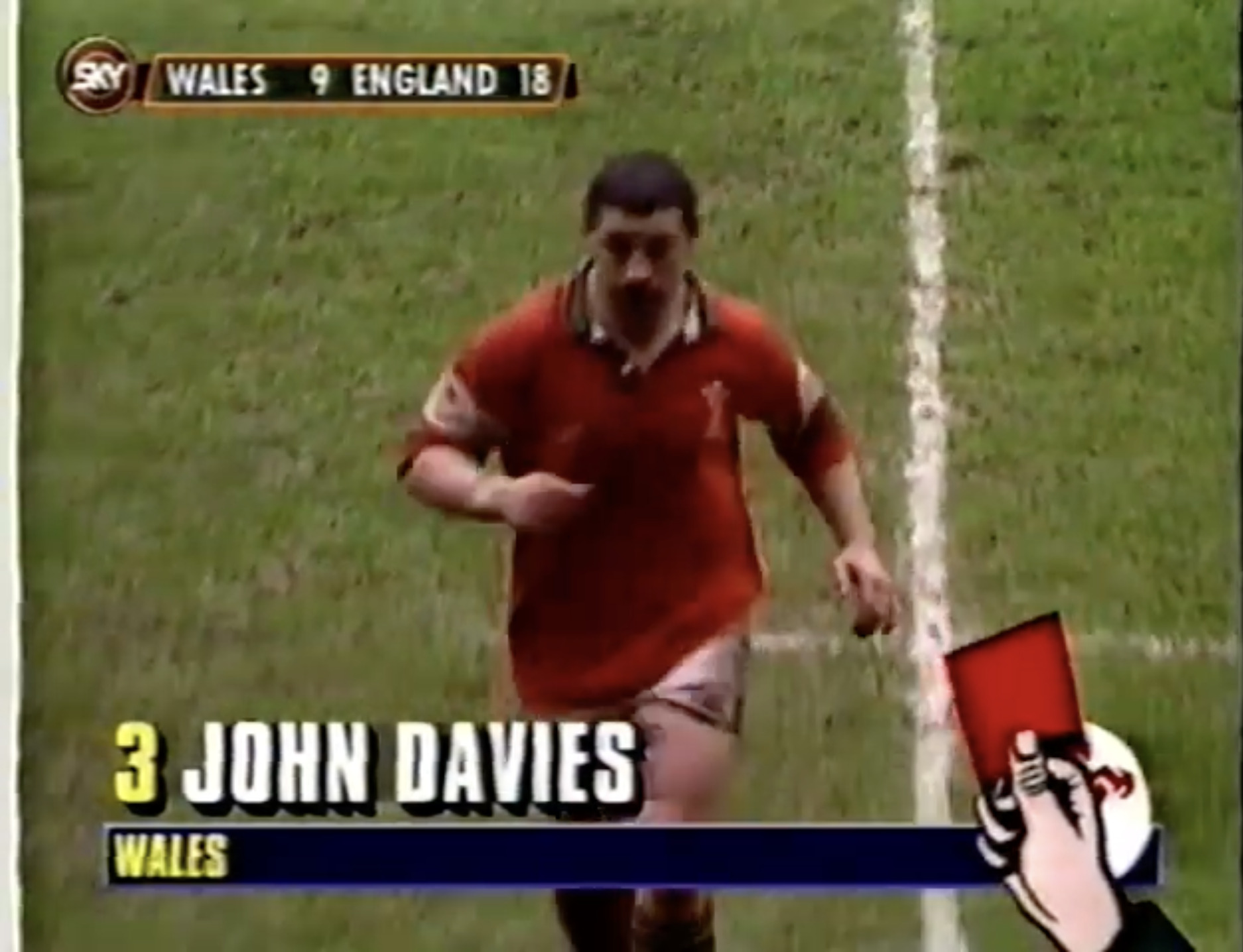
Whilst cards were officially adopted in 1995, the adoption of physical red cards seems to have been clunky. The first physical red card to be shown in an international match was to Wales’ John Davies during the 1995 Five Nations. Davies was sent off for kicking England’s Ben Clarke, the same player who had been the first to receive a yellow card, on the ground. Whilst the cameraman misses referee Didier Mene showing the card on the television feed, a clear photo was published in the South Wales Argus two days later. For the television audience, the TV graphic shows a red card, and television commentator Miles Harrison confirms it was a red card, not a yellow1617.

Four players were sent off during the 1995 Rugby World Cup18, three of whom were sent off in South Africa’s pool-stage game against Canada. It has been reported that Canadian fly half Gareth Rees keeps a framed version of his red card in his home19; however, this is perhaps unlikely as the three players sent off during that game were not actually shown red cards, rather they were sent off the pitch using hand gestures20. In the French commentary for Tonga’s Feleti Mahoni’s sending off against France in the same contest, they do refer to ‘le carton rouge‘; however, a red card cannot be seen on screen21. The next piece of clear video evidence of a red card shown to a player during a test match happens to come from the 1997 Tri-Nations Series, with Springbok Andre Venter being shown a red card for stamping on the head of All Black captain Sean Fitzpatrick on the 9th August 199722.
Since the introduction of cards in 1995, their frequency has increased dramatically. In the pre-card era, fighting was occasionally punished with a sending off, and the definition of dangerous play seems to have been decapitation. In the post-card era, however, accidental and purposeful foul play has been punished by time-outs and exclusions freely. Each World Cup seems to result in more cards than its predecessor, whilst countries such as England23 have become well known for their discipline-related issues and players such as Tomas Lavinini, Taine Plumtree and Poppy Cleall have gained reputations for being ‘card magnets’. Whilst cards are generally associated with either purposeful or accidental injury or risk of injury to a fellow player, repeated penalties and technical issues are also known to result in cards. Cards becoming punishment for technical infringements is generally the result of widespread bending of the rules across a period of time. For example, the yellow card for a failed interception/cynical knock-on is a result of widespread cynical play in the eighties and nineties24.
2022 saw the trial of the 20-minute red card during The Rugby Championship25; this came after trials during Super Rugby in Australia and New Zealand. Whilst the issue of a red card would previously mean that teams would be down a player for the remainder of the game, the 20-minute red card would allow for a dismissed player to be replaced after twenty minutes. Proponents argued that it meant that individuals were punished rather than teams, whilst allowing for a distinction to be made between accidental and purposeful foul play. Critics cite a trivialisation of head injuries and less of a deterrent for high tackles. After a strenuous two years, the 20-minute red card made its way to World Rugby-run tournaments in 2024 and its widespread adoption in 2025.
Those who did not watch the Argentina v England match may assume that it was a dirty game filled with fighting; however, in reality it didn’t seem that different from your average modern game, aside from one notable moment towards the end. In the days following the game, World Rugby confirmed that Argentinian flyhalf Tomás Albornoz would face additional disciplinary action for his post-match behaviour towards referee Angus Gardner26. Referee abuse on social media, most often following the showing of a card or lack thereof, has led to leading referees such as Wayne Barnes retiring from the sport and others to restrict access to their social media. Criticism from rugby professionals towards referees has also been on the increase, with coaches Rassie Erasmus, Eddie Jones, Gonzalo Quesada and Ronan O’Gara having all faced sanctions for their comments on referees. Players such as Mack Hanson and Pauline Bourdon Sansus have also faced bans due to their comments in post-match interviews regarding officiating, despite in both cases the players calling for higher standards on the grounds of player safety. Despite this, physical confrontation has thankfully remained relatively rare. At the international level, the Albornoz incident is the only such confrontation which springs to mind, although Johnny Sexton was sanctioned in 2023 as a result of a sideline confrontation following Leinster’s loss to La Rochelle in the Champions Cup final, which resulted in him missing World Cup warm-up matches. It is also hard to forget that Georgian referee Nika Amashukeli was stabbed following a 2016 Georgian domestic match by a member of the RC Army Tbilisi team staff27. It seems that many forget that cards are issued as a result of a player’s behaviour and not a referee’s.
As a retired flanker, I am not unfamiliar with yellow cards. However, after the yellow card-palooza of Argentina v England, I decided that I had to look into their history. I watched a fair amount of old matches and looked through newspaper archives to try and pinpoint the exact dates and referee actions involved as various contradictory accounts are given regarding cards, but I hope I’ve provided a bit of clarity.
If you would like more regular updates, please check out my Instagram, Facebook, Twitter, and/or Bluesky. You can also catch me podding with WRRAP or with Women’s Rugby Treehouse somewhat regularly this summer.
An audio version of this post is also available in all good podcasting locations, and video versions are now available on YouTube and Spotify. As always, references are below.
-Hattie
Thanks for reading The Rugby History Project! Subscribe for free below to receive new posts.
If you would like to help support the project financially, you can find the details here.
- Six yellow cards: Fiji with 5 and Italy 1. ↩︎
- “Fiji Launch Complaint after Being Reduced to 11 Men – ESPN,” ESPN.Com, November 21, 2013 <https://www.espn.co.uk/rugby/story/_/id/15332429/fiji-launch-complaint-being-reduced-11-men>. ↩︎
- “South Africa v Argentina – The Rugby Championship 2022,” World Rugby <https://www.world.rugby/beta/match/29672>. ↩︎
- “Argentina v England – Nations Championship 2026,” World Rugby <https://www.world.rugby/beta/en/match/87dd888e-aa41-4817-9cd3-58b51052db3b>. ↩︎
- World Rugby Museum, “Edward Turkington – a Unique Distinction,” World Rugby Museum, February 13, 2023 <https://worldrugbymuseum.com/from-the-vaults/players/edward-turkington-a-unique-distinction>. ↩︎
- Unnamed American Journalist in World Rugby Museum, “Edward Turkington – a Unique Distinction.” ↩︎
- USA Rugby wouldn’t join the IRB until 1987. ↩︎
- World Rugby Museum, “Sending off Is No Longer the Ultimate Disgrace?,” World Rugby Museum, October 20, 2022 <https://worldrugbymuseum.com/from-the-vaults/international-rugby/sending-off-is-no-longer-the-ultimate-disgrace>. ↩︎
- The future Edward VIII, who later become infamous for his abdication. ↩︎
- Lynn McConnell, “40: The Brownlie Dismissal Analysed,” Silver Fern Sports, January 16, 2025 <https://lynn.substack.com/p/40-the-brownlie-dismissal-analysed>. ↩︎
- A form of official warning used in Association Football. ↩︎
- Rugby365, “Red and Yellow Cards,” Rugby365, May 18, 2007 <https://rugby365.com/laws-referees/red-and-yellow-cards/>. ↩︎
- Paul Dobson, “History: Sin Bin and Colourful Cards,” Rugby365, July 1, 2008 <https://rugby365.com/laws-referees/news/history-sin-bin-and-colourful-cards/>. ↩︎
- Several of these developments were later adopted upon the dismantling of Apartheid and the reintroduction of South Africa into wider rugby competitions; the most well-known of these would be line-out lifting. ↩︎
- John Griffiths, “Wartime Autographs, Official Tests, Yellow Cards and Tri-Nations Runs – ESPN,” ESPN.Com, September 28, 2009 <https://www.espn.co.uk/rugby/story/_/id/15294440/war-autographs-official-tests-yellow-cards-tri-nations-runs>. ↩︎
- SJT Rugby Union, “Wales v England Five Nations Rugby Union 18-02-1995,” YouTube, June 14, 2024 <https://www.youtube.com/watch?v=oUWR_K2bnLg>. ↩︎
- In the match footage, which is a 30-minute video of extended highlights, there is a really funny moment where the commentary team are horrified by the fact that a tactical substitution is brought on to complete the scrum. ↩︎
- Two were sent off in 1991, I also checked that footage, they were sent off with hand signals. ↩︎
- “Canada and South Africa Have a Fight-Filled History at the Rugby World Cup,” Lethbridge News Now, October 7, 2019 <https://lethbridgenewsnow.com/2019/10/07/canada-and-south-africa-have-a-fight-filled-history-at-the-rugby-world-cup/>. ↩︎
- Rétro Foot, Rugby, Basket et autres sports, “SOUTH AFRICA – CANADA (RUGBY WORLD CUP 1995 : FULL MATCH),” YouTube, August 11, 2024 <https://www.youtube.com/watch?v=16DJCl4ZT2Y>. ↩︎
- Full80Rugby, “France v Tonga | 1995 Rugby World Cup | Pool D | Full Game,” YouTube, March 19, 2026 <https://www.youtube.com/watch?v=yQC8ikHXyiM>. ↩︎
- RDGraeme, “Incident – Fitzy Face Stamped,” YouTube, January 28, 2009 <https://www.youtube.com/watch?v=rucZdKT8rCM>. ↩︎
- Men’s and Women’s. ↩︎
- Paul Williams, Rugby Has F***ing Laws Not Rules (Polaris Publishing, 2021), pp. 49. ↩︎
- The successor to the Tri-Nations Series. ↩︎
- Ben Smith, “Argentina’s Albornoz Charged Following Altercation with Match Officials,” Rugbypass, July 23, 2026 <https://www.rugbypass.com/news/argentinas-albornoz-charged-following-altercation-with-angus-gardner/>. ↩︎
- John Jones, “Rugby Referee Nika Amashukeli Was Stabbed after Previous Match,” Wales Online, February 15, 2026 <https://www.walesonline.co.uk/sport/rugby/rugby-news/scotland-v-england-referee-nika-33412826>. ↩︎
Leave a Reply