
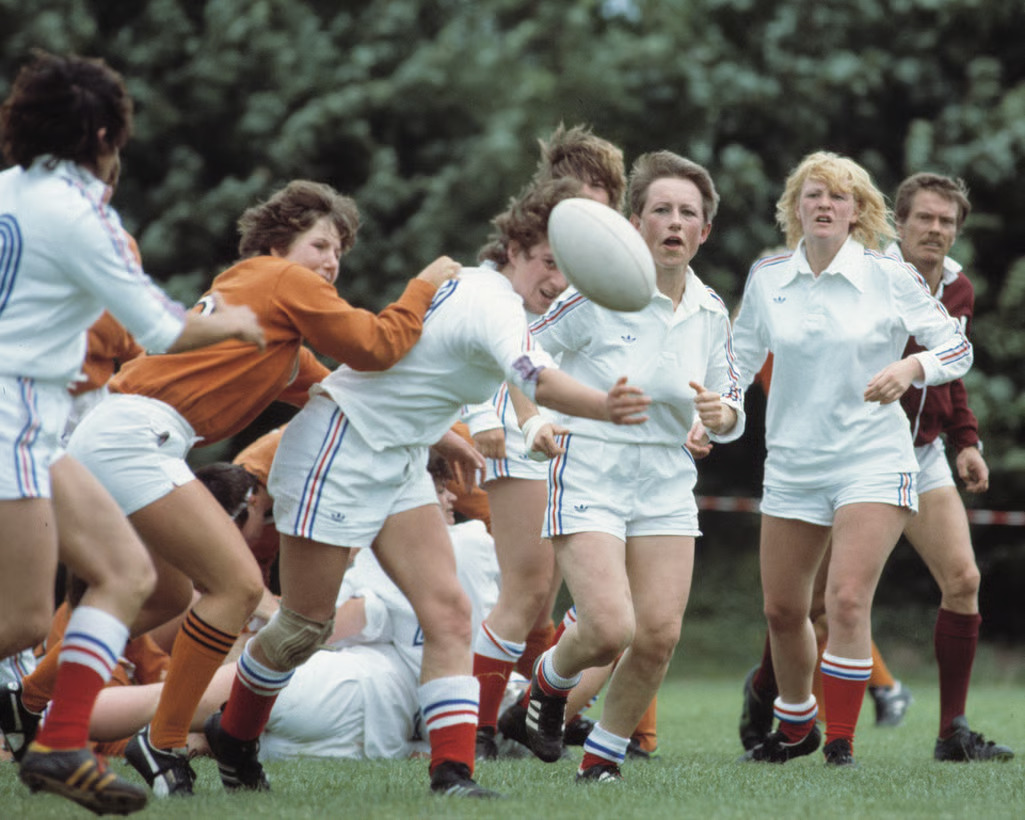
On the 13th June 1982, the Netherlands and France took part in the first ever women’s international test match. Whilst the Netherlands lost at home, France became the first-ever lineal world title holders, a title they will fight to regain this Sunday against England in the final game of the 2026 Women’s Six Nations.
On a Saturday evening in June 1982, a group of twenty-one French women undertook a 500km coach journey to the Dutch city of Utrecht. At 3pm the following day, they, along with their Dutch counterparts, made history as the first ever female international rugby union players. The match at Sportpark Strijland sparked a legacy, that of the Utrecht Shield, with France being its first holders.

The women’s game in France was well established by 1982, with some teams closing in on two decades of history and multiple leagues having run for over ten years1. Dutch women’s rugby was far newer, although rugby in the Netherlands was far newer on the men’s side also. The Rugbyclub Wageningen had formed its men’s side in 1970. To celebrate their five-year anniversary, the club decided to host a women’s game featuring the partners and female relatives of their male players2. The success of the game, which was only meant to be a novelty, resulted in club sides being set up across the country. Despite its later start, support for the women’s game in the Netherlands was enthusiastic, several university teams existed, and, unusually for the era, it was governed by the national rugby union, the NRB3.

The first women’s test match was the brain-child of two revolutionary rugby figures. Dutch rugby official Leo van Herwijnen devoted his life to growing the game in the Netherlands. He was heavily involved in the founding of several clubs and even set up his own foundation, the aim of which is to preserve Dutch rugby history4, however, in the 1980s, he was in the infancy of his rugby advocacy. Whilst van Herwijnen had come to the game late, only discovering it when his children began to play, his French counterpart Henri Fléchon was somewhat of a rogue stalwart in his home nation. Fléchon was a respected referee with the FFR, the French national union, until he refused to abide by the FFR ban on union referees officiating women’s rugby matches. At the time, women’s rugby was governed by the Association Française de Rugby Féminin5, a separate organisation, which legally meant it was possible for the FFR to enact a ban. However, Fléchon disagreed with the concept of a ban, as it would effectively stop safe play in the women’s game. Whilst the FFR referee ban fell apart, Fléchon found himself central to the AFRF administration as he was quickly elevated to organisation president6.

1982 was panning out to be a big year for the NRB, as they were celebrating their fiftieth anniversary. Similarly, it was a big year for women’s rugby in France, as the AFRF would be absorbed into the FFR at the end of the year under Fléchon’s guidance. Fléchon’s reputation as an administrator of the women’s game had reached the Netherlands, and as such van Herwijnen reached out to set up a meeting to discuss best practice for governing the women’s game. Both sides were impressed with the other’s approach, with Fléchon impressed with how the NRB accepted women, and van Herwijnen impressed with the overall structure of the women’s game in France7. As a result of the meeting, the Dutch decided to set up a women’s national team and invited the French to take part in a match to celebrate the fiftieth anniversary of the NRB8.


Despite the tight turnaround time, with just a few months between the invitation and the match itself9, both sides were able to put together competitive sides. The Dutch held regional trials to select their playing pool, and held training games between April and June 1982, whilst the French selected a representative side from five clubs10 and conducted a singular training camp11. Whilst some of the Dutch players had never played a game of fifteen-a-side rugby union, many of the French players were incredibly experienced, with the French outside centre Monique Fraysse having played for over twelve years12 with modern powerhouse Toulouse. Somewhat surprisingly, the first half of the game was extremely competitive, with neither side’s attack managing to get through the other’s defence. In the second half, however, the more experienced French side pulled through, with winger Isabelle Decamps scoring the game’s only points. With tries only being worth four points at the time, the final score was 0-4.
‘Representing France meant that women’s rugby would be able to move forward. It was also a personal reward. We were there, we were not going to back down. I recall the shape of the Dutch players, all dressed in orange. They were young, tall, strong and they passed the ball very well.’
-Monique Fraysse, French outside centre, 202013

Despite the unions being the ones to organise the game, the players themselves paid for their jerseys, transport and accommodation14. The French players wore white, rather than their traditional blue, and were not allowed to wear the Gallic rooster on their chest, instead wearing a tricolour stripe down the arms of their jersey. The Dutch wore their traditional orange; however, as we can see with Hanneke Brouwer’s jersey from the return fixture the following year, they wore repurposed football jerseys1516.


Neither side backed down or away from the international game, as they played return fixtures in 1983 and 1984, both won by France. In 1984, the Netherlands faced Sweden for the first time, and the following year, France played Italy. The game in Riccione, Italy was the first time in which a team other than France or The Netherlands competed for the Utrecht Shield. Whilst the draw meant that the French retained their title, it was a landmark game.
‘What if every result mattered? What if rugby had a central unifying trophy – one that followed the game itself, moving match by match across continents and competitions? It wouldn’t replace existing trophies; it would strengthen international rugby, ensuring that every result matters beyond rankings or tournament tables.’
-Dave Algie, Guardian of the Utrecht Shield, 202617

The Utrecht Shield, like her brother the Raeburn Shield, is the brainchild of Dave Algie18. The shields track the lineal world champions match by match, since 1982 and 1871 respectively. The idea to track the lineal world title holders began after the 2007 Men’s Rugby World Cup, when Dave’s beloved All Blacks exited the tournament early. Although a much trickier task, he also began tracking the women’s data too, the motivation to do so increasing after watching the Black Ferns dominate the 2010 Women’s Rugby World Cup in person19. As of 2026, Dave has devoted almost two decades of his spare time, and a fair amount of cash, to the project. Whilst the shields now form a limited company in order to deal with British bureaucracy, Dave himself stresses that the shields really belong to the players and the public. Whilst the ultimate goal would be to have the shields exchanged on pitch following a steal, for now, you can often find Dave and his kids at games with the shield, offering stickers and the opportunity to take a photo.

‘I’ve always loved women’s rugby, and I’ve always been a bit of a stats nerd, but really it’s the stories and the connections that get me. The Utrecht Shield lets us take those trailblazers from 1982 and draw a line all the way through to today and beyond. Those women gave so many of us so much joy, and they deserve to be connected to every great player who’s come since. If we can make rugby more fun, why wouldn’t we?’
-Dave Algie, Guardian of the Utretcht Shield, 202620
England’s Red Roses are the current holders of the lineal world title, having taken the shield after beating Canada in October 2024. At 18 defences, the run is equal to their best ever run in the mid-nineties, and only two games short of the Black Ferns record of twenty21. However, on the 17th May 2026, they will face the French in Bordeaux. Having conceded just 49 points in four games, the French are on a defensive hot streak. In comparison, the Red Roses are facing an injury crisis at lock and have conceded try bonus points from the Welsh and Italian sides for the first time in their history. If the French manage to beat their greatest rivals in Bordeaux, not only would they win a Grand Slam, but the Utrecht Shield would be returned to them, almost three years after they last held it. This would top off a historic campaign, which started with the recognition of the 1982 squad at their opening game against Italy.


I’ve had the Utrecht game/shield on my ‘to-do list’ for a while, and seeing as we are headed for a shield showdown in the final match of the Six Nations, it felt apt to cover it as the last part of my Six Nations series. If you would like to check out the other articles I have written in this wider series, you can find those here. I’ve also recently created some ‘just say no to dainty lady balls’ stickers in protest of the ball trial, which will take place later this year. You can find those on my Redbubble here and my post about the history of the rugby ball here. I’d also like to give a huge thank you to Dave for helping me out with details about the Utrecht shield AND providing lots of great photos. If you head over to his website here you can find great statistics and other great snapshots of the shield’s adventures.
I hope that you have enjoyed this post. If you would like more regular updates, please check out my Instagram, Twitter, and/or Bluesky. I’ve also recently started a Facebook page if that’s more your vibe. You can also catch me podding every Tuesday morning with WRRAP or with Women’s Rugby Treehouse somewhat regularly.
An audio version of this post is also available in all good podcasting locations, and video versions are now available on YouTube and Spotify. As always, references are below.
-Hattie

Thanks for reading The Rugby History Project! Subscribe for free to receive new posts. If you would like to help support the project financially, you can find the details here.
- Ali Donnelly, Scrum Queens (Pitch Publishing, 2020), pp. 40. ↩︎
- “13th June 1982: The Day It All Began,” Scrum Queens <https://web.archive.org/web/20130723010608/https://www.scrumqueens.com/features/13th-june-1982-day-it-all-began>. ↩︎
- Donnelly, Scrum Queens, pp. 41. ↩︎
- “The Foundation,” Leo Van Herwijnen Rugby Foundation <https://lvhrugbyfoundation.com/the-foundation.html>. ↩︎
- French Association of Women’s Rugby in English or AFRF. ↩︎
- Donnelly, Scrum Queens, pp. 41. ↩︎
- Donnelly, Scrum Queens, pp. 41. ↩︎
- Donnelly, Scrum Queens, pp. 41. ↩︎
- “13th June 1982: The Day It All Began.” ↩︎
- Interestingly their side included three sets of sisters. ↩︎
- worldrugby.org, “The Story behind the First-Ever Women’s International | World Rugby” https://www.world.rugby/news/570629/premier-match-rugby-international-feminin-1982-annick-jambon-monique-fraysse-viviane-berodier. ↩︎
- worldrugby.org, “The Story behind the First-Ever Women’s International | World Rugby.” ↩︎
- Fraysse in Donnelly, Scrum Queens, pp. 42. ↩︎
- Donnelly, Scrum Queens, pp. 42. ↩︎
- World Rugby Museum, “🤩 RECENT ACQUISITION 🤩 Hanneke Brouwer Played at Fullback for the Netherlands in the First Women’s International Rugby Match, against France in 1982. This Number 12 Jersey Was Worn by Her in the Return Match the Following Year, and Is Currently on Display in the Museum.,” X (Formerly Twitter), June 25, 2025 <https://x.com/wrugbymuseum/status/1937820728897761436>. ↩︎
- Brouwer started at fullback in the 1982 game but moved to inside centre for the 1983 game. Her jersey from the second game was donated to the World Rugby Museum in 2025. It is clearly a 1982 Dutch Men’s National Football Team jersey. ↩︎
- Algie in Julian, “Uncovering the Oldest Treasure in Women’s Rugby.” ↩︎
- Or as I like to call him, Dave the Shieldman. ↩︎
- Adam Julian, “Uncovering the Oldest Treasure in Women’s Rugby,” Newsroom, January 25, 2026 <https://newsroom.co.nz/2026/01/26/uncovering-the-oldest-treasure-in-womens-rugby/>. ↩︎
- Dave Algie, interview with the author, 6th May 2026. ↩︎
- “Utrecht Shield Data Summaries — THE RAEBURN SHIELD & UTRECHT SHIELDs,” THE RAEBURN SHIELD & UTRECHT SHIELDs <https://www.raeburnandutrechtshields.com/utrecht-shield-data-summaries>. ↩︎


Leave a Reply