
Following their 2014 Rugby World Cup win, the Red Roses recorded their worst-ever result in the Six Nations. This is the tale of how the World discovered the Red Roses were not perennials.
On the 14th August 2014, the Red Roses lifted the World Cup trophy for the second time in their history, beating North American opposition to become World Champions, the same way they had done so twenty years previously. In their next game, 179 days later, England would be nilled by Wales for the first time in their history. Recording losses against Wales, Ireland, and France, and wins against Scotland and Italy, the 2015 Women’s Six Nations was the worst on record for the Roses. But how exactly did they wilt so fast, and how did they revive themselves to win the 2017 competition?

The Six Nations in the mid-2010s was perhaps one of the most competitive eras of the contest. Three different nations had taken home the trophy in the three years previous to 2015, with Ireland winning the championship for the first time in their history in 2013. As the World Champions, England should’ve been clear favourites for the trophy, but newspaper reports from the time show a different story. It is not unusual for a tournament-winning team to undergo some form of malaise the following season. Newspapers compared the Red Roses to the England Men’s team from 2003, questioning if the Roses would also fail to live up to their World Cup glory. With players retiring, the need to bud new players and a new coaching regime, it was expected that the Red Roses could wilt slightly. However, the 2015 Red Roses underwent massive, and primarily unnecessary, changes, which caused some pretty shocking results for the World Champions.
Only three of England’s starting 15 retained their place between the 2014 World Cup final and the opening game of the 2015 Six Nations. Rocky Clark and Tamara Taylor retained the number one and four jerseys respectively, whilst Kay Wilson shifted from left-wing to fullback. In total, only nine players from the 2014 match day 22 remained in the 2015 opening match day 23, the extra game day player coming from the changes to World Rugby front row regulations. Talismanic flanker Maggie Alphonsi had retired following the World Cup win, whilst winger Kat Merchant had been forced into medically required retirement due to head injuries in the autumn. The loss of both players was always going to be a struggle for the team; they were just two of the players unavailable for the tournament. The sheer volume of which was certainly a thorn in the side of the English coaching team. A coaching team lacking World Cup-winning coach Gary Street, who abruptly left the programme only weeks before kick-off1.
Streets departure from the Red Roses despite his success was shocking to many at the time; however, it has since been reported that the beloved coach was potentially no longer a fit for the RFU Women’s programme, who were focused on high-performance sevens in preparation for the 2016 Olympics2. Street had been a part of the Red Roses programme for over 8 years, the majority of which he had served as Head Coach. Unlike many other male coaches of the era who saw women’s rugby as a stepping stone, Street had deep roots in the women’s rugby community, having first coached a women’s side in 19923. His wife, Helen Flippance was a ‘Vintage Rose”4 who received nine caps in the early 2000s, previous to his selection as coach, at blindside flanker5 and was a mainstay at the domestic powerhouse of Richmond RFC. Street was to be replaced by sevens coach Simon Middleton; however, Middleton was in the middle of the sevens season and therefore unavailable. This led to the squad being coached by Head of Performance Nicky Ponsford. Whilst Ponsford was a former Red Rose with over a decade of experience in high-performance management, she had no experience in coaching international rugby6.

Whilst the choice to focus on sevens may have resulted in the removal of Gary Street, it was certainly the reason for the rather empty Red Roses roster. During their World Cup run, much had been made of the amateur status of the Red Roses. Their football, hockey and cricket national counterparts were all professional by this point, and it was surprising to many that a team such as the national rugby team were not. Less than two weeks after their World Cup win, the news was leaked to the Telegraph that twenty players, twelve of whom had played in the World Cup, had signed professional contracts7. Despite much of the reporting being focused on the World Cup winning squad and many of the players signing their contracts on the bus to the World Cup itself8, the contracts were for rugby sevens, not fifteens and meant that the majority of these professional players were now unavailable for Six Nations selection. Of particular concern would be the loss of fly-half and captain Katy McLean and the World Cup’s top point scorer Emily Scarratt. The loss of these leadership options was heightened by the loss of experienced number 8 Sarah Hunter, who had previously stood in as captain when McLean and Scarratt had been away on sevens duty, due to a knee injury.

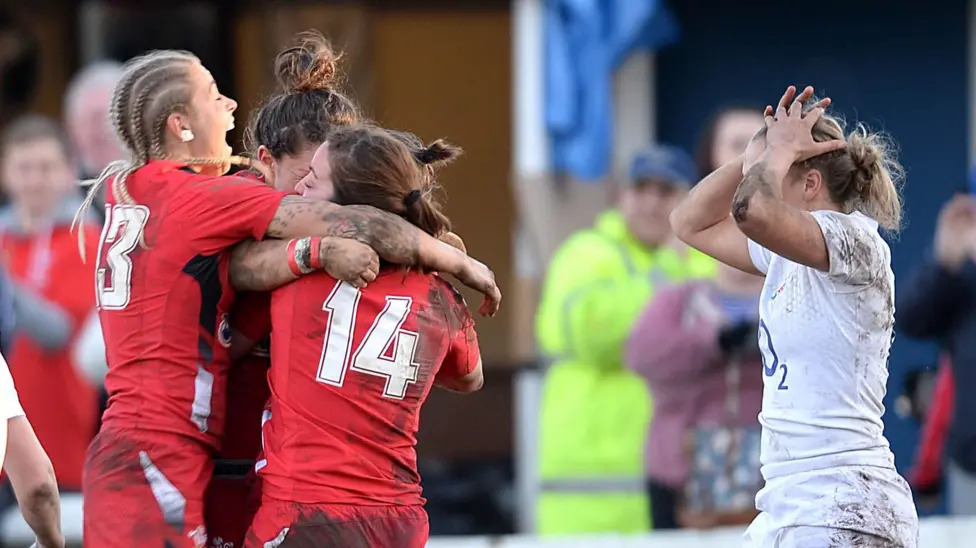
Sunday, 8th February 2015, is more fondly remembered by Welsh fans than English. The final game of the first round of the 2015 Women’s Six Nations was predicted by many to be a more competitive game than the previous year, which had ended 35-3 to England, due to the aforementioned missing English players. Despite this, Wales’ win was so shocking that it made it into mainstream press coverage. Unconverted tries from Catrin Edwards and Laurie Harries put Wales up 10-nil by the fiftieth minute; Harries followed up with a final penalty at the seventy-sixth minute to secure a 13-0 win over the English in Swansea. The footage and still images from the win are iconic, reeled out and mentioned almost every year since 2015. However, it is not the tale of a plucky underdog, but rather one of an extremely inexperienced team led by an inexperienced coach who underestimated a far more stable side with home advantage.
Whilst only conceding two tries and a penalty kick, England’s nilling was the real concern. Whilst fly-half Ceri Large and scrum-half La Toya Mason were both experienced players, they had primarily been used as bench options behind McLean and Mo Hunt. Aside from Kay Wilson at fullback, the other backs were relatively inexperienced, with inside centre Megan Goddard and winger Ruth Laybourn having both been fringe-squad members and outside centre Abbie Brown and winger Sydney Gregson both receiving their first caps against Wales. In total, there were a whopping seven new caps against Wales.

The unexpected first-round loss against the Welsh sent the RFU into a tailspin. Whilst it is likely that the French and Irish squads were always seen as a threat to the RFU, it is unlikely that a loss to the Welsh was seen as a possibility. Whilst a second or third place finish wouldn’t have been preferred for the World Champions, slumping past further than third was unthinkable.
England’s two wins in the 2015 Six Nations came against Italy in week two and Scotland in week four; both countries were in a period of rebuilding after failing to qualify for the 2014 Rugby World Cup9. Just under 3000 people watched the Roses fire past the Azzurri at the Stoop10 for a 39-7 win. English fans in Darlington were treated to a 42-13 win against the Scots a few weeks later. The wins were aided by the return of Katy McLean, who had been drafted in to not only start at fly-half in week two, but also reclaimed her captaincy in week three11. Whilst sevens players such as Sarah McKenna helped to bolster the squad in some rounds, the bench was propped up by Amber Reed, who was slowly returning from injury. The return of McLean was a clear attempt to stop the wilting of the Red Roses.
“Everybody is aware we’re in a rebuilding phase so that game was very important to us. I’ve got six caps less than the rest of the back line put together. This Six Nations is going to be hard and that result will really help. It’s more wide open than it has ever been. We want our sport to be recognised and the only way that happens is with competition increasing.”
-Katy McLean, Following the 2015 Six Nations win over Italy12

Unfortunately for the RFU, whilst the Roses overcame Italy and Scotland, they faced defeat at the hands of Ireland and France. Whilst England led for most of their game against Ireland, a seventy-fourth-minute penalty kick from Niamh Briggs put Ireland in the lead at home. France bounced back from a 17-12 loss to Italy to beat England 21-15 at Twickenham. Thanks to a Jessy Tremouliere kicking masterclass, France were able to secure a second-place finish in the tournament, with Ireland taking home the crown thanks to their superior points difference. With bonus points yet to be a part of the competition, England only had 4 table points, making them joint fourth with Wales. However, due to their large wins over Italy and Scotland, England were logged as fourth rather than fifth. Following the final-round loss to France, Nicky Ponsford was forced to defend the team against accusations of ‘decline’ from journalists13.

The rest of 2015 was a rollercoaster for the Roses. Simon Middleton officially took over as head coach of both the English sevens and fifteens programmes14 and appointed second-in-command Scott Bemand. Despite this, it took a period of time for the new programme to bed in. A loss to New Zealand in the summer’s Super Series, followed by a second loss to France in the autumn, meant that 2015 was the second most losing year on record for the Red Roses15. Sevens stars such as Marlie Packer and Emily Scarrett16 were able to return to fifteens in late 2015 following the conclusion of the short-form season; however, the majority of contracted players were once again missing from the Six Nations in 2016.
A far more settled side took the field in 2016. Sarah Hunter returned from injury to captain the side, whilst a fully fit Amber Reed took the reins at 10. Attack coach Scott Bemand coached the side due to Middleton being with the sevens programme. Whilst Bemand had little international coaching experience, he had spent time working under Middleton in the Red Roses environment. With the new caps from 2015 now having had a year of development in a high-performance environment, the team was able to win four games; however, they yet again fell to France, securing a second-place finish. It wouldn’t be until the 2017 Six Nations that the Red Roses returned to full bloom, winning their thirteenth grand slam and fourteenth overall title.
The preference for rugby sevens within the RFU’s women’s programme following the 2014 World Cup win harmed fifteens. The team was due to undergo a rebuilding period anyway, with player retirements and only a three-year turnaround until the next World Cup. However, the RFU withdrew their best players for the sevens circuit, leaving the fifteens side short of experienced talent. It should also be said that many of the 2015 contracted players have since said that sevens was not the game for them due to tactical and fitness issues17; however, the opportunity to be professional was too great a reward. Looking back, it is also possible that if Gary Street had been in post to bring the team through the period of transition, they may have been able to see different results.
Whilst the Red Roses wilted in 2015, it is safe to say the experience resulted in a far stronger programme. Players such as Abbie Ward, Amy Cokayne and Meg Jones were capped during the period of transition. It was also the only major period in which rugby sevens was prioritised in such a fashion in England. Whilst other women’s programmes have been built on the back of dual-coders, due to the talent pool and structure of the European international season, such a system would not guarantee success in both codes for the English. Whilst dual-coders still exist in English women’s rugby, it is not to the same extent as, say, Canada or New Zealand.
Whilst the Rugby Football Union’s decisions caused the Red Roses to wilt initially, ultimately, it allowed them to bloom.

I blooming love the Women’s Six Nations, and this is the second of three posts I hope to write this year. If you would like to check out the other articles I have written in this wider series, you can find those here. They all contain significantly fewer flower puns.
I hope that you have enjoyed this post. If you would like more regular updates, please check out my Instagram, Twitter, and/or Bluesky. I’ve also recently started a Facebook page if that’s more your vibe. You can also catch me podding every Tuesday morning with WRRAP or with Women’s Rugby Treehouse somewhat regularly.
An audio version of this post is also available in all good podcasting locations, and video versions are now available on YouTube and Spotify. As always, references are below.
-Hattie
Thanks for reading The Rugby History Project! Subscribe for free to receive new posts. If you would like to help support the project financially, you can find the details here.
- Michael Aylwin, “England’s World Cup Winners Head to Wales after Whirlwind,” The Guardian, February 7, 2015, section Sport, p. 5. ↩︎
- Owen Slot, “Moving Tale of Gary Street, England’s Forgotten World Cup Winner,” The Times, September 23, 2025 <https://www.thetimes.com/sport/rugby-union/article/gary-street-england-women-head-coach-red-roses-xlxz9z7mh>. ↩︎
- Glyn Brazell, “Gary Street,” Pitchero, February 22, 2024 <https://www.pitchero.com/clubs/astonoldedwardians/news/gary-street-2834999.html>. ↩︎
- Jessica Hayden, The Red Roses: Behind the Scenes with the England Women’s Rugby Team (Arena Sport, 2024), pp. 25. ↩︎
- Richmond and Twickenham Times, “Six Nations Glory for Richmond Women,” Richmond and Twickenham Times, April 4, 2003 <https://www.richmondandtwickenhamtimes.co.uk/sport/286616.six-nations-glory-for-richmond-women/>. ↩︎
- Aylwin, “England’s World Cup Winners Head to Wales after Whirlwind.” ↩︎
- Benedict Smith, “Escenic,” The Telegraph <https://www.telegraph.co.uk/sport/rugbyunion/international/england/11053391/England-Women-Rugby-World-Cup-winners-to-paid-to-play-RFU-announces.html>. ↩︎
- Hayden, The Red Roses: Behind the Scenes with the England Women’s Rugby Team, pp.37. ↩︎
- In 2014, England, France, Ireland, Wales, Spain and Samoa qualified for the contest through the Europe region. Despite being in Oceania, Samoa took part in the European Qualification Tournament. ↩︎
- Gerard Meagher, “Katy Mclean Returns to Inspire England to Six Nations Win over Italy,” The Guardian, February 15, 2015 <https://www.theguardian.com/sport/2015/feb/15/england-women-italy-six-nations-match-report>. ↩︎
- BBC Sport, “Women’s Six Nations 2015: Katy Mclean Regains England Captaincy,” BBC Sport, February 25, 2015 <https://www.bbc.co.uk/sport/rugby-union/31621146>. ↩︎
- McLean in Meagher, “Katy Mclean Returns to Inspire England to Six Nations Win over Italy.” ↩︎
- Gerard Meagher, “England Women’s Defeat to France Not a Sign of Decline, Nicky Ponsford Says,” The Guardian, March 22, 2015 <https://www.theguardian.com/sport/2015/mar/22/england-women-defeat-france-not-sign-of-decline-nicky-ponsford>. ↩︎
- He would also be the head coach of GB Sevens at the 2016 Olympics. ↩︎
- They lost 7 games in 2013, 3 of which were during a tour to New Zealand. ↩︎
- “New Zealand v England – Women’s Rugby Super Series 2015,” World Rugby <https://www.world.rugby/beta/match/22255#lineups>. ↩︎
- The Good, The Scaz & The Rugby, “Going for Gold with the GB7s Girls #81,” YouTube, May 30, 2024 <https://www.youtube.com/watch?v=ZXPb2i059hU>. ↩︎
Leave a Reply