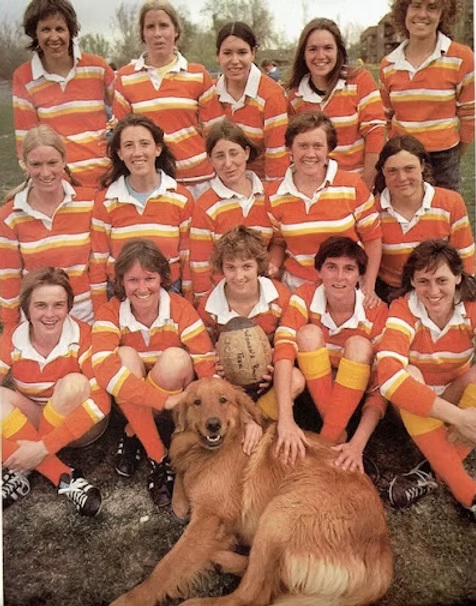
How a counter-culture movement and a landmark civil rights case created the first World Cup winners.
In the Autumn of 1972, two groups of Colorado university students unwittingly started a movement. Providing queer and straight women a safe space to play a full-contact sport, this was a direct response to a vulgar display of misogyny they had witnessed over a year previously and buoyed by a landmark civil rights case. This is the tale of the women who refused to go away.

In 1971, those who attended Aspen Ruggerfest were ‘treated’ to a “powderpuff” rugby match1. Exhibition American football matches played by teenage girls are a tradition at many American high schools. The games are meant to be a spectacle, as feminine girls take on a masculine sport they have not trained for. The aim of the powderpuff rugby match was to entertain the crowd, who had gathered to watch men’s rugby. However, the match greatly irritated University of Colorado Boulder student Trudi Foreman and her friends. Inspired, the group decided to play the sport. Female students from both the University of Colorado Boulder and Colorado State University2 began training in earnest, and just over a year later, the two teams met for their first game. This was not the first-ever serious women’s rugby match in the United States; previous games had been held in the late 1960s. It is, however, the first game that can be linked to the continuous movement that still exists today.
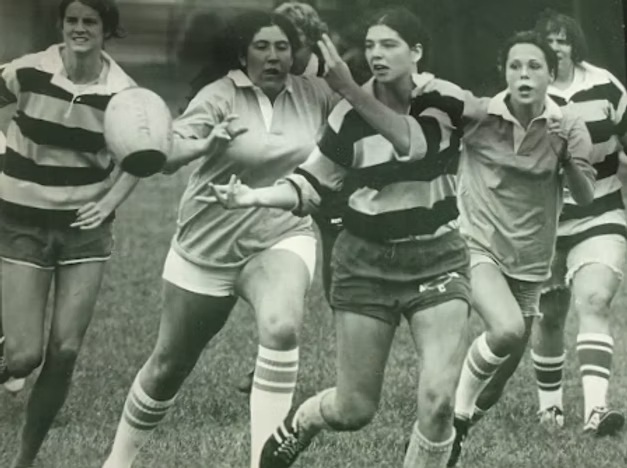
The Colorado students who took up rugby were a part of a much greater, non-rugby movement taking place in the United States during the late sixties and seventies. The college system was expanding at a rapid speed, with a larger proportion attending tertiary institutions of learning than ever before3. Specifically, the number of women attending college increased dramatically. Between 1960 and 1975, the percentage of female high school graduates attending college increased from 37% to 49%, whilst the overall number of young women graduating high school almost doubled in the same period4. With the increase in women in tertiary education, and inspired by the wider civil rights movement of the era, legislation to combat widespread sexism came into being.
Title IX did not start life as a sports-based bill. Originally, Title IX came into being in response to the exclusion of education and academia from previous executive orders which prevented sex based discrimination5. However, during the long process to get the law signed6, it became clear that sports would become a huge part of Title IX. Whilst the original aim of Title IX was to prevent the preferential treatment men received in programme admissions and academic job applications, the broad language used in the act meant that it could be easily applied to athletics.
Athletics had always been a huge part of the American collegiate system. Originally based on the ideals of Muscular Christianity, major men’s team sports such as football7, basketball and baseball had become major cultural phenomena which could produce revenue for the institution8. In 1972, women made up 42% of college students9, but only 1% of college athletic budgets went to women’s sports programmes10. Under pressure from the main governing body of collegiate athletics, the NCAA, which generally opposed the legislation, as well as women’s sports advocates, the vague language of Title IX was clarified through further guidelines for all levels of education. In light of concerns about the effects of truly equal access to women’s sports from football advocates, it was decided that institutions would be judged on a schoolwide basis rather than on individual teams, whilst skill was a key criterion when deciding which sports would be offered to women at a varsity or NCAA level. Women would be granted equal opportunities11 and accommodations12 to play sports along with equitable13 funding. Title IX’s impact on sports was revolutionary, but by design and implementation, it has never provided truly equal opportunities and funding to women’s and men’s sports. Whilst Title IX has never been perfect, it did bring the concept of women playing sport to the forefront.
‘No person in the United States shall, on the basis of sex, be excluded from participation in, be denied the benefits of, or be subjected to discrimination under any education program or activity receiving Federal financial assistance.’
-Title IX Of The Education Amendments Of 197214
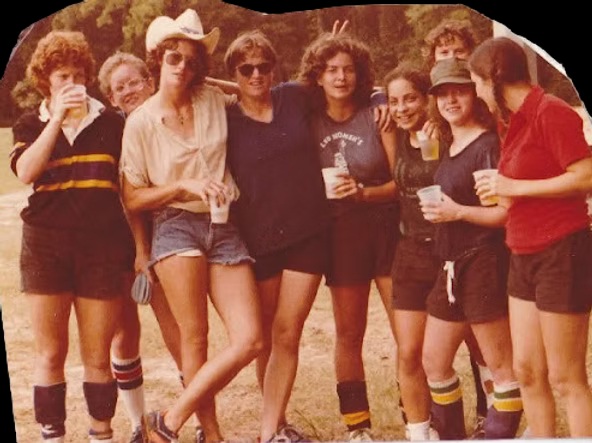
Rugby had been reintroduced to American colleges in the late 1950s. A club sport15, rugby was seen as a pastime rather than a more serious, varsity sport such as football or basketball. For club sports, skill was not deemed a criterion in participation, and they were not governed by the NCAA. Title IX would go on to become a significant distinction in the development of women’s rugby in the United States in comparison to their international counterparts. Title IX had not only brought women’s sport to the forefront, but as rugby was a club sport, and therefore no apparent ‘skill’ delineation could be used to stop women from playing it, any of the possible, minimal, funding given to a men’s rugby team by an educational institution was in theory required to be given to a women’s team (if one existed) at the same institution16.
In the five years following the 1972 Colorado game, 109 women’s rugby teams had been formed across the United States17. Two years later, 210 teams were in existence18, primarily based either at universities or in university towns. Despite this, female rugby players had no representation within USA Rugby until 1979, despite the union only being formed in 197519. In 1979, Elissa Augello, better known as “Jello”, took the revolutionary step of bringing together representatives from the four geographic regions of American rugby to form the USA Rugby Women’s Committee20. Due to apathy from the men in charge of USA Rugby, the Women’s Committee were largely independent and free to do as they pleased. Due to their official membership of USA Rugby, female players were forced to pay dues to both their national and regional unions, but outside of the women’s committee, they had no representation at any level. As one administrator is quoted as saying by Kerri Heffernan in her 2026 book No Advantage Given, ‘we thought you’d just go away.’21
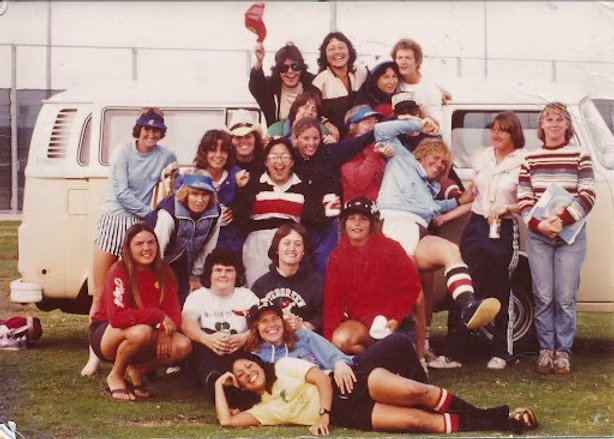
On the pitch, USA women’s rugby was perhaps the most developed in terms of competitions and tournaments. Regional and ‘territorial’ competitions fed into the National Championships from 197822. However, the large geographic area which these contests covered meant that unsafe playing conditions were frequent. With long travel distances required and players working around work and study commitments, multiple games were often played across only a few days. Portland Maine won the first National Championship in 1978, playing four games in two days, according to player Marybeth Matthews.
Domestic travel was not the only travel female American players undertook. American women were the first to undertake international rugby tours. American women’s rugby teams began international touring in 1977; however, in 1979, a Midwest representative side travelled to Great Britain23, ostensibly to play British teams. Unfortunately, the Midwestern side were unable to organise any matches with British sides and ended up simply playing each other. The San Diego-based Rio Grande Surfers were perhaps one of the most well-travelled teams, with documented tours to Aotearoa New Zealand and Great Britain, along with an infamous trip to Ireland thanks to a sexist ‘prank’ by male Trinity College players in 1983. International women’s rugby had begun in 1982, but was confined to Western Continental Europe with infrequent, one off games. The Wiverns24 of 1985 were the first women’s American representative side, although not officially recognised by USA Rugby. Touring Great Britain, in agreement with the Women’s Rugby Football Union25, as well as France, the Wiverns tour not only showed European rugby fans what women’s rugby could be but also how far behind European women were. The USA side dominated their opponents during their two-week tour, and the games made national newspapers in Britain.
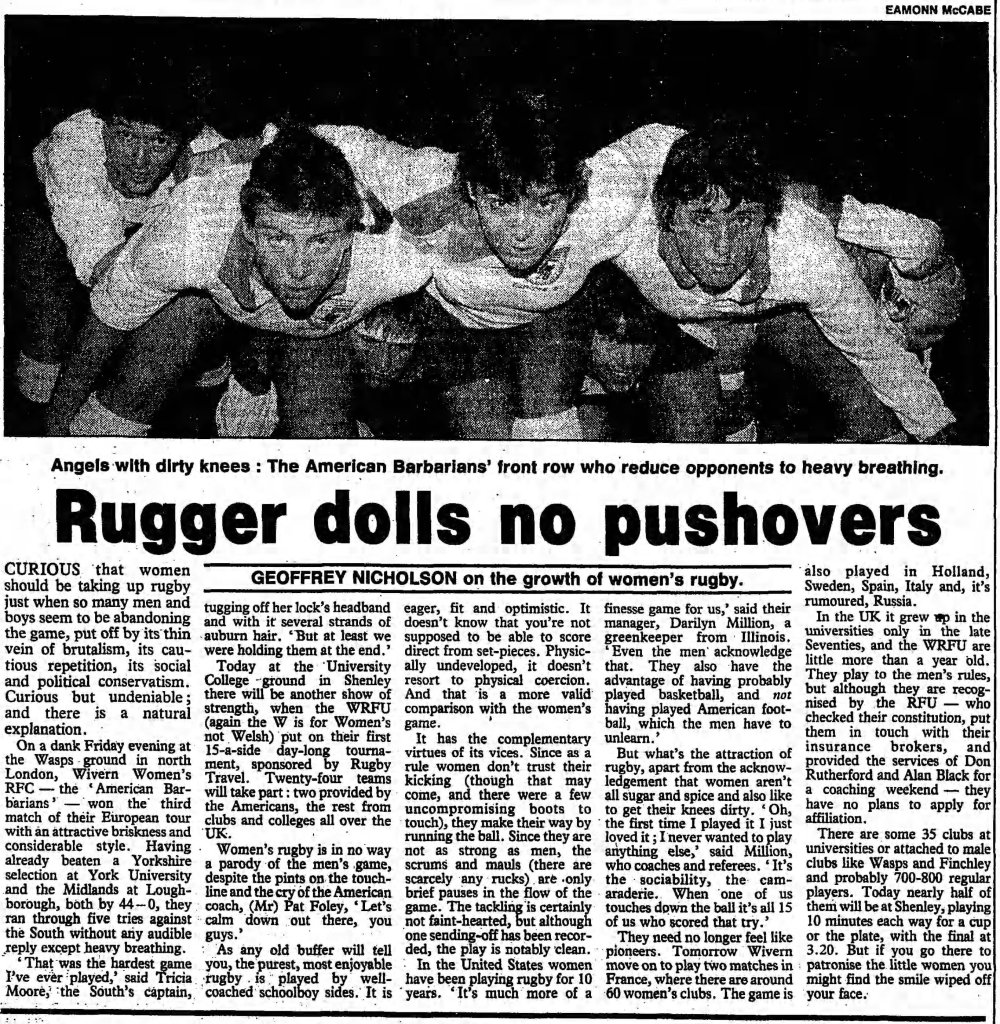
The first representative side to use the USA moniker, although not the USA Rugby ‘Eagles’ branding, was the 1986/87 side. Brought together for training camps in 1986 and playing their first test match in 1987, the USA Women’s National team was officially born. In the four years between their first test match and their Rugby World Cup win, the USA played just a handful of games against Canada and three games in Aotearoa in 1990 as a part of RugbyFest. Despite being a part of a non-traditional, newer national union, the national team faced significant backlash from their own rugby community. The most notable and significant pushback came after the team’s first international test. An unofficial double header with their male counterparts, the USA women’s side were victorious whilst their male counterparts had failed to overcome the Canucks. In a joint post-match banquet organised by Rugby Canada, the USA Men’s captain Fred Paoli used his mic time to denounce women’s rugby and criticise the fact that the wives of the USA Men’s team had not been invited to the banquet when the Women’s team had been invited26.
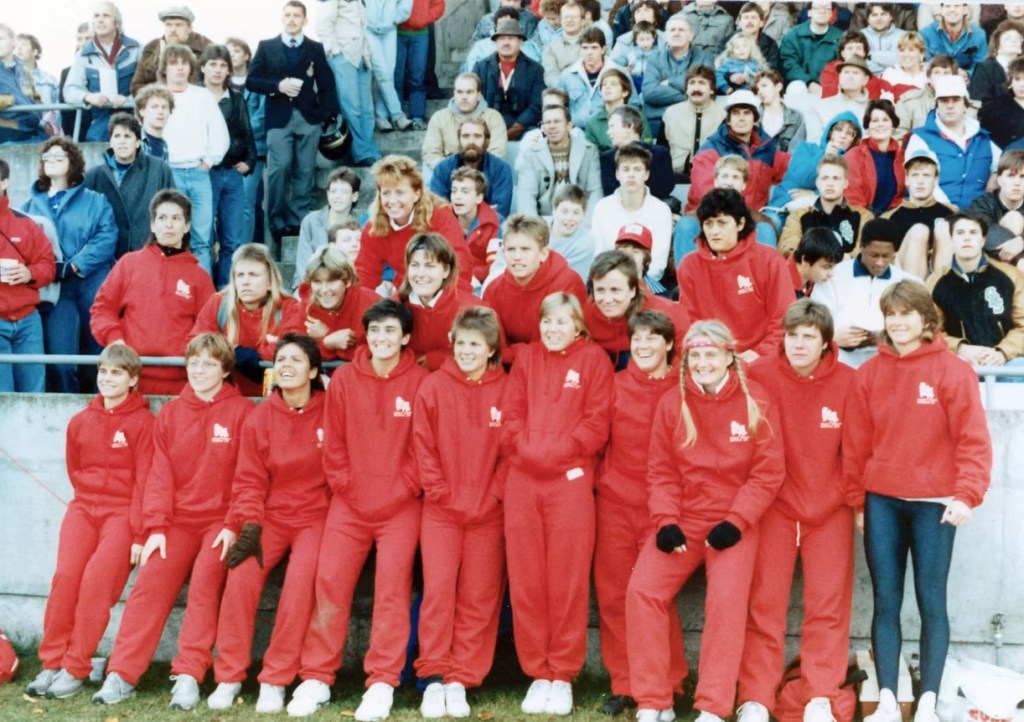
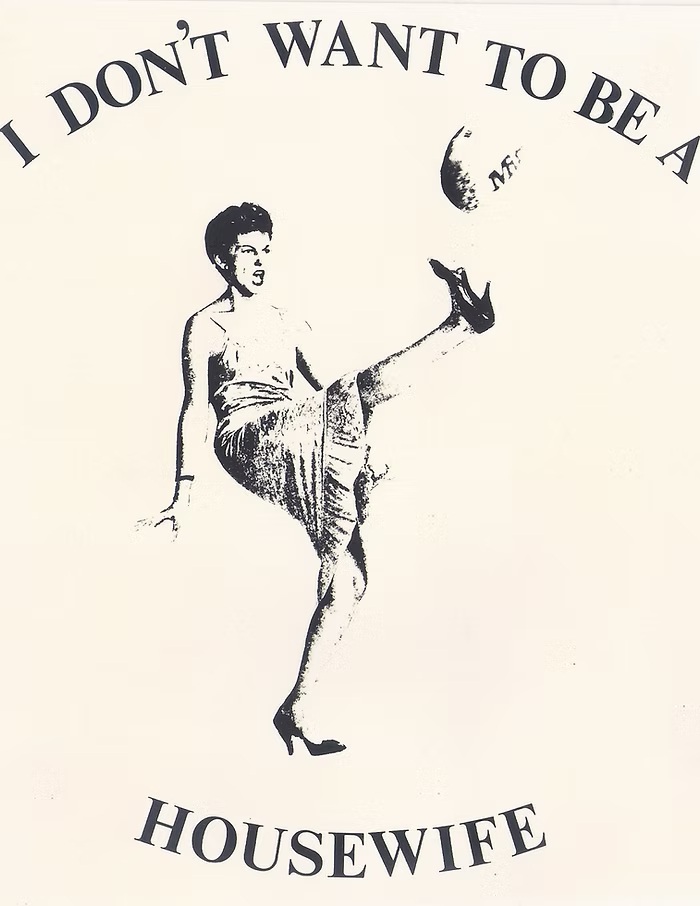
Women’s rugby in the USA had a distinct culture. Whilst rugby generally had a large counter-culture element, with heavy drinking and general ‘rowdiness’ a large part of its sporting culture, unlike in traditional rugby nations, it was not unusual for women’s rugby teams to be completely separate from their male counterparts, apart from at large tournaments such as New York Sevens 27. Mixed rugby tournaments were simultaneously a safe and unsafe space to be a woman. Men’s rugby had strong misogynistic factions, with sexual assault and homophobic attacks common at tournaments and gatherings28, whilst rugby advertising often used degrading images of women with men in positions of power. At the same time, women’s rugby was widely known, and often derided, for its accepting culture29. Many female rugby players were queer, referred to in code as ‘raging feminists’ by the media30, and women’s rugby teams were often places of refuge for young queer people. Many teams were subversive and openly twisted the ideals of femininity and misogynistic culture with team names such as the The Eugene Housewives31. The traditions of being both subversive and a queer refuge have continued until the current era, with clubs and teams across the United States widely denouncing USA Rugby’s ‘trans ban’.
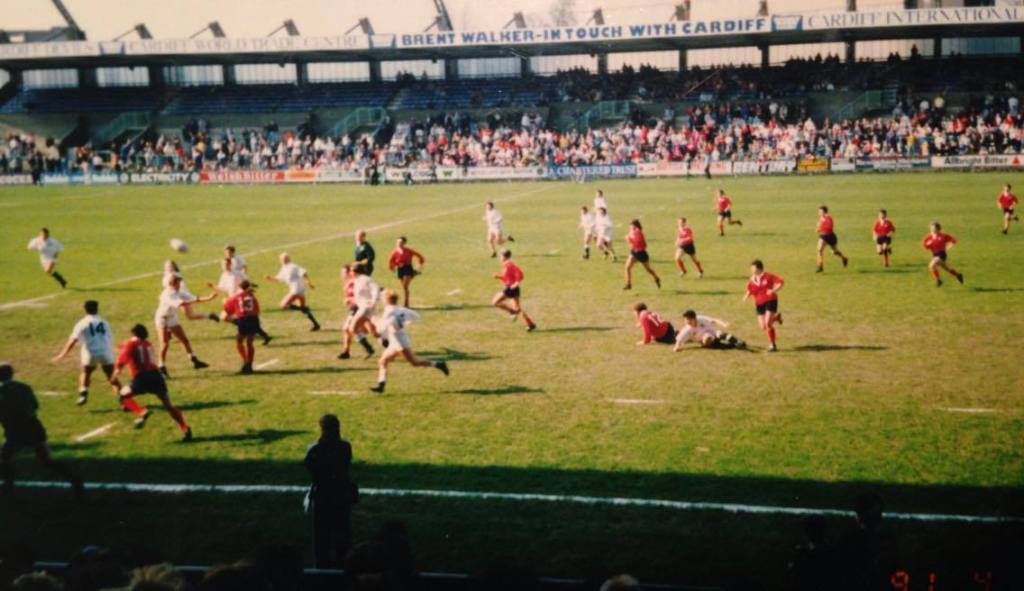
Whilst the team that played at the 1991 Rugby World Cup was not the most internationally experienced team, they were incredibly well developed. In just under two decades, not only had teams and leagues developed, but administrators and advocates had developed networks and systems. Women were not just on the pitch, but they were forcefully integrating with the male factions at USA Rugby and even refereeing games. In small pockets of the country, such as in Fairfax, Virginia, teenage girls were picking up the sport at their high schools32. Coinciding with the signing of Title IX and its rollout, women and girls were given the chance to play instead of just watching. With close to no investment or existing male infrastructure, women’s rugby in the USA was perhaps the most developed in the world at the 1991 Rugby World Cup. Whilst it surprises men’s rugby fans in 2026 that the USA won the first-ever Women’s Rugby World Cup, in 1991, it came as no shock to anyone in the women’s rugby sphere that the USA took home the gold.
I’m writing this author’s note whilst, rather fittingly, watching the NCAA Women’s Basketball National Championship game on my sofa in the UK on Disney+. This post required me to do a lot of background research on Title IX, something which I had seen mentioned in passing frequently but never fully explained. Whilst Title IX didn’t directly impact rugby massively during the early days, it did help transform women’s sport in the US during the 1970s.
I hope that you have enjoyed this post, if you would like more regular updates, please check out my instagram, twitter and/or bluesky. I recently had a good old chat with my friend Huw about class and rugby which you can find on YouTube here. You can also catch me podding every Tuesday morning with WRRAP. An audio version of this post is also available in all good podcasting locations, and video versions are now available on YouTube and Spotify. As always, references are below.
-Hattie
Thanks for reading The Rugby History Project! Subscribe for free to receive new posts, or consider upgrading to Historian Tier to support the project!
- Heffernan, Kerri, No Advantage Given (Stillwater River Publications, 2026), pp. 3. ↩︎
- Referred to as CU and CSU, respectively, from this point on. ↩︎
- National Center for Education Statistics, “College Enrollment Rates of High School Graduates, by Sex: 1960 to 1998” <https://nces.ed.gov/programs/digest/d99/d99t187.asp> ↩︎
- National Center for Education Statistics, “College Enrollment Rates of High School Graduates, by Sex: 1960 to 1998.” ↩︎
- Boschert, Sherry, 37 Words: Title IX and Fifty Years of Fighting Sex Discrimination (The New Press, 2022), pp. 29. ↩︎
- As a part of the Education Amendments of 1972. ↩︎
- Of the American variety. ↩︎
- Many major men’s collegiate sports programmes actually lose money due to overspending. ↩︎
- School Enrollment in the United States: 1972 (US Department of Commerce, September 1972) <https://www2.census.gov/library/publications/1973/population/p20-247.pdf> ↩︎
- “Feminist.Com Explainer: Title IX” <https://feminist.com/resources/explainer/title-ix.html> ↩︎
- Measured through equal access to athletic scholarships. ↩︎
- E.g. not the same sports. ↩︎
- Less. ↩︎
- Title Ix Of The Education Amendments Of 1972, U.S. Department of Justice (United States Congress) <https://www.justice.gov/crt/title-ix-education-amendments-1972> ↩︎
- That is, a student-led sport with little to no involvement from the institution it represented. ↩︎
- Ali Donnelly, Scrum Queens (Pitch Publishing, 2020), pp. 49. ↩︎
- Heffernan, No Advantage Given, pp. 11. ↩︎
- Heffernan, No Advantage Given, pp. 23. ↩︎
- Heffernan, No Advantage Given, pp. 14. ↩︎
- Heffernan, No Advantage Given, pp. 14. ↩︎
- Unnamed USA Rugby Administrator in Heffernan, No Advantage Given, pp. 14. ↩︎
- Heffernan, No Advantage Given, pp. 13. ↩︎
- Heffernan, No Advantage Given, pp. 23. ↩︎
- Women’s Invitational Vagabonds, Emissaries and Rugby Nomads ↩︎
- Britain and Ireland’s governing body for women’s rugby at the time. ↩︎
- Donnelly, Scrum Queens, pp. 60. ↩︎
- “History,” New York Rugby Club <https://www.newyorkrugby7s.com/history>. ↩︎
- Heffernan, No Advantage Given, pp. 20. ↩︎
- Heffernan, No Advantage Given, pp. 17. ↩︎
- Heffernan, No Advantage Given, pp. 17. ↩︎
- WRCRA, “The Eugene Housewives 1979-1989: When Fun Ruled,” USWRF-WRCRA, September 8, 2020 <https://www.uswrf.org/post/the-eugene-housewives>. ↩︎
- Heffernan, No Advantage Given, pp. 29. ↩︎
 Home
Home 
Leave a comment