
The Rise and Fall and Rise Again of the Irish Women’s National Rugby Team
On the 30th September 2024, Irish rugby fans woke up to the news that the Ireland had beaten New Zealand. Fans of the men’s team rejoiced that the women’s team had finally achieved the same feat the men had come to hold so dear. Imagine their shock when fans of women’s rugby informed them that the women’s team had not only beaten New Zealand before, but that they had made a Rugby World Cup bronze final too.
Women’s rugby in Ireland has a complex origin story. Whilst Emily Valentine was documented as having played the game alongside her brothers and their classmates in the 1880s, women’s rugby in Ireland didn’t begin in earnest until the late twentieth century. Whilst women had played a role within rugby culture, by running club kitchens and washing kit, they had been excluded from playing. The Irish Women’s Rugby Football Union was founded in 1992, independently from the IRFU which governed the mens game in Ireland, and also from the WRFU1, putting out their first representative side a year later in 19932. The women’s game in Ireland developed a lot slower than it did in neighbouring nations, with England and Wales playing their first games in 19873. Historian Liam O’Callaghan notes in his book, Blood and Thunder, that Ireland were one of the last major rugby playing nations to adopt the women’s game45.

Whilst the 1970s and 80s saw the growth of the women’s game across both the Irish Sea and the Atlantic, growth of the game in Ireland was extremely limited. The first exhibition game was held between University College Dublin and Trinity College in 1973, but this game, along with any subsequent games, was seen as a ‘skit’ or as a negative aspect of second-wave feminism6. The worst yet most telling story from this era however involves a team that didn’t exist. In 1983, a group of male Trinity College students, reportedly from the men’s rugby team, contacted the Rio Grande Surfers, a team based in San Diego, and invited them to play a game against the Trinity College women’s team. Except Trinity didn’t have a women’s team. The elaborate ‘prank’ came to its conclusion when the Americans arrived in Dublin, having paid out of pocket for the trip, leading to an embarrassing moment for the institution and their student union. Quotes from those close to the incident suggest that the college was embarrassed by the negative press rather than the actions of privileged and bigoted young men. When speaking to the press at the time, the Trinity Recreation Officer tried to make light of the situation by stating ‘needless to say we don’t have a rugby team for women.’7
With pushback from Dublin’s traditional rugby institutions of Trinity and UCD, it would be out in Tallaght that women’s rugby first properly took hold in Ireland. Despite Tallaght being deemed a ‘non-traditional rugby area’8 and not having a men’s rugby team until 2006, Tallaght Ladies was founded in 19859. Three years later Susan Mannion attempted set up a women’s rugby team at Queens University Belfast. What is particularly interesting about Mannion is her rejection of a feminist identity. Whilst feminism and queer identities were key parts of women’s rugby movements during the 1980s10, Mannion openly rejected this idea in the press11. The attempt to de-politicise women’s rugby reflects both the non-political public image of the IRFU12 and Mannion’s attempt to seek wider acceptance for women playing rugby.
‘The prospect of thirty women knocking each other about on the field does not appeal to me.’
-Karl Johnston, The Evening Press, 1990
‘Having never seen women’s rugby, maybe I shouldn’t comment.’
-Also Karl Johnston, also The Evening Press, also 199013

When Ireland made their international debut in 1993 against Scotland, many of the Irish based players were extremely new to the game of rugby. The more experienced players in the side were generally based on the other side of the Irish Sea, with many qualifying for Ireland through ancestry. The inexperience of the Irish based players came primarily through the difficulty of playing the sport in that era. Many early teams struggled to find opposition competition and players themselves facing public stigma for playing the game. Whilst senior figures in Irish rugby, such as Alain Rolland14, were supportive of women’s rugby, the game was largely unsupported.
‘Basically we are living in a country where rugby is still a very chauvanistic old school sport.’
-Carole Ann Byrne, Ireland Women’s National Team Captain, 199715
One of the only long form, first hand accounts of Irish women’s rugby in the 1990s is the 2025 memoir of former dual code international Jackie McCarthy O’Brien. Titled We Made It, Kid, the book follows O’Brien from her difficult childhood, to her debut for the Irish National Soccer team, her retirement and subsequent adoption of the code of rugby union. O’Brien was the first Black woman to play for Ireland in both soccer and rugby union, switching codes after being assaulted by soccer coach Mick Cooke16. O’Brien describes both the national rugby team environment, as well as her club and provincial sides, as supportive of both her as a single mother and as a queer woman, two things which were not widely accepted in Ireland, or the national soccer team, at the time. O’Brien’s teammates family members would often babysit O’Brien’s children, allowing her to play worry free.

O’Brien’s memoir not only details the positives of being a female rugby player in Ireland at the time, but also the negatives. Long travel for weekly matches, low attendances and, most importantly, a pay to play model for the national team. Gaining 13 caps for the national team, O’Brien was required to pay for the overseas tournaments she took part in, including the 1994 European Championships and 1997 Rugby World Cup. O’Brien retired from international rugby in 1997 and all forms of rugby the following year.
The mid-1990s saw the advent of the Women’s Home Nations17. Unfortunately for Ireland they recorded a third place finish in 199618 and then two consecutive wooden spoons. In 1999, European giant France joined the competition, resulting in yet another bottom of the table finish for Ireland. With little domestic support, the IWRFU decided to withdraw from the Five Nations in order to develop the domestic game. During their two year hiatus from the competition, the IWRFU affiliated themselves with the IRFU. Whilst this meant that the IRFU now had some interest in the women’s game, they still did not run the game. In 2002, Ireland re-entered the competition, creating the Women’s Six Nations, but unfortunately they would continue to sit in the bottom half of the table until 2010.

The IWRFU would continue to govern the women’s game until 2009, upon which the IRFU assumed full control. It had become the norm for the amateur women’s unions to cede control to the professional organisations, with Welsh, Scottish and English women’s rugby doing the same in this era. During a period of global economic turmoil, women’s rugby and their dedicated unions were being held back by small cash flows, a small profile and few opportunities. The merging process was not without its hiccups, infamously the IRFU’s subpar travel arrangements left the team exhausted prior to their away fixture against France19. Upon reflection, it could be fair to say that the control lost by experienced and dedicated servants of the women’s game did cause problems in the long term. However, by merging with the much larger national union, women’s rugby in Ireland, for a period, was able to reap rewards.
‘Travel for away games was often done on a shoestring, to the detriment of performance. Most notable was the trip to Pau to play France where the team flew to Paris, got stuck in rush hour traffic, missed a train and had to take an overnight train via Bordeaux. A trip where there was nowhere suitable to sleep, especially not for athletes competing at international level the next day. They got three hours sleep in their hotel before running out against their opponents.’
-Ailbhe O’Nolan, 202420
2013 would turn out to be a seminal year for the Irish team. The team had firmly been considered to be the “best of the rest” for several years, consistently able to pummel the likes of Scotland but unable to put away the tournaments perennial winners, England, and runner up, France. Off the back of discussions following the 2012 travel issues, 2013 saw Ireland achieve a feat the women’s team had never accomplished: a Six Nations Grand Slam.
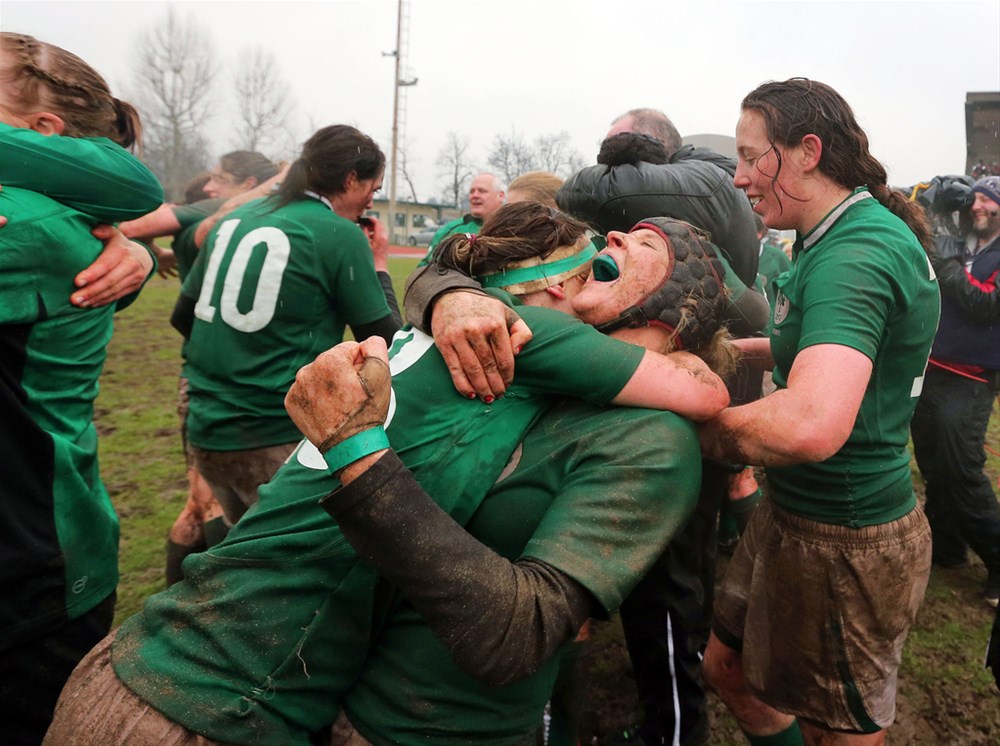
With professionalism yet to make major changes to women’s rugby21, and England undergoing their own governance changes, Ireland were able to utilise a golden generation of players, along with structural changes such as the reintroduction of the Irish Exiles programme and the advent of an inter-provincial series22, to achieve 5 straight wins. Connacht wing Alison Miller scored a tournament high of five tries, whilst Munster’s stalwart fullback Niamh Briggs recorded 43 points23. Other standout players from the Irish team included prop Fiona Coughlan, lock Sophie Spence, back-row duo of Claire Molloy and, future international referee, Joy Neville, and a centre partnership of Jenny Murphy and Lynne Cantwell. After a close win over rivals Wales, Ireland shocked many by holding England pointless in their second match. Ireland would go on to record wins over Scotland and France24 before celebrating a narrow win over Italy in Milan on a very muddy St. Patrick’s Day25.

Two years later, Ireland would go on to win both the Six Nations and the Triple Crown, although they fell short of a repeat Grand Slam due to a 5-10 loss to defending champions France. In Ireland’s second match of the tournament, and their first home game, Ireland not only battled their opponent but also their own grounds. Whilst the men’s side had moved into the newly built, fifty thousand seat Aviva Stadium in Dublin’s prestigious Dublin 4 postcode in 2010, the women’s side played their home international test matches at a grass roots club in County Meath. Ashbourne RFC usually hosts fixtures for Leinster’s Men’s Second Division, but it had been selected by the IRFU to be Ireland women’s home ground for much of the early 2010’s. Whilst it has been common to play women’s international test matches at grounds not suitable for elite competition, Ashbourne had particular faults. In the Friday night test against the French, the floodlights failed, creating a significant delay in a game which had already begun26. Whilst the game was eventually completed, the more experienced French team took the win. Ireland would continue to use Ashbourne RFC as their home ground throughout the campaign, celebrating their home win over England at the ground just two weeks later.
‘Has the penny dropped yet? The arrival of women’s rugby is for keeps. Despite the agonising 10-5 loss to Six Nations Champions France, Ireland’s status as sporting heroines remains intact and surely, after Friday night’s farcical events, they have earned a modern stage to show their worth. … The RDS and Donnybrook were empty tonight. So too Thormond Park. A healthy crowd of about 2100 crammed into the Meath venue. Lots of French visitors, sniggering at Ireland’s inability to play a Test Match in a proper stadium.’
-Gavin Cumminsky, 201527
The Rugby World Cup often carries heavy expectations for Irish rugby fans, with fans of the men’s team often caught unawares when then team traditionally exits the tournament during the quarter-finals. However the 2014 Rugby World Cup gave the union their best ever result for a senior side.
The national team had taken part in every single edition of the Rugby World Cup apart from the first in 1991, which had predated the teams debut. Prior to 2014, the team didn’t exactly light the world on fire. However, with their grand slam winning team, they were able to achieve something neither Irish senior team have done before or after: play in a third place playoff game. Ireland had a difficult draw, playing against Asian powerhouse Kazakhstan, former champions USA and reigning champions New Zealand. Aotearoa had not lost a match at the World Cup since 1991 and were on a 20 match winning streak prior to their first ever game against the Irish on the 5th August 201428. In an upset for the ages, Ireland beat New Zealand 17-14, with an Allison Miller try that would go on to become legendary. Topping their group, Ireland advanced straight to a semi-final against eventual tournament champions England29. Whilst Ireland went on to lose their final two games of the competition, they ended up with a fourth place finish and the bragging rights of having a 100% win rate over the Black Ferns.

Following the success of the 2014 World Cup, and 2013 and 2015 Six Nations, many fans were hopeful that this could be the start of a dynasty, especially as the country was set to host the 2017 Rugby World Cup30. In reality, the chances of success at a home World Cup had begun to dwindle in the same year in which the team had beaten the Black Ferns for the first time. Fans of the team have suggested that the hiring of High Performance Director David Nucifora in 2014 can be linked to the downturn of the performance of the women’s fifteens team. The admission of rugby sevens into the Olympics resulted in many unions, and their countries respective Olympic committees, funding professional or semi-professional contracts and funding for women’s rugby sevens. The exact level of preference given to sevens over fifteens in Ireland in the decade following 2014, however, is notable. One of Nucifora’s leading legacies at the IRFU was the increased funding of rugby sevens in Ireland. From the outside this sounds like a great premise, funding a short form version of the sport and eventually allowing a select group of female athletes to benefit from professional contracts. In reality the bias towards sevens aided in hampering the development of the women’s game in Ireland, and as a result the national team. Unfortunately, whilst England and France began investing heavily in broader aspects of the women’s game, Ireland did not outside of its sevens programme, leaving them to fall behind its counterparts.
The 2017 Rugby World Cup, in hindsight, was not the best showing of the sport. With contracting crowds in comparison to 2014, criticism from players surrounding the organisation31 and general lacking of any ‘spectacle’ at the event. All of the pool stage was held at University College Dublin, with players given on campus accommodation. There was poor communication at the venue, which led to crowds far smaller than the ticket sales would suggest3233. Even more disappointing was the result for the national side, as a loss against France and close wins over Australia and Japan resulted in them not advancing to the semi-finals, instead settling for eighth place34, narrowly missing out on automatic qualification for the 2021 Rugby World Cup. The failure to secure an automatic qualifying spot for the next World Cup led to head coach Tom Tierney’s resignation35. Following this, the IRFU advertised the position as a part time role36.
The years following the 2017 Rugby World Cup could be described as the darkest in Irish women’s rugby history. Poor conditions at events such as the Super Series in 2019 and the Interpros in 202137 as well as the disastrous 2020 jersey launch38, shone a light on the underlying values of the IRFU and their thoughts on women’s rugby. The 2021 Interpros were perhaps the most egregious. With the highest level of the women’s domestic game in Ireland classed as ‘non-elite’ under Covid-19 regulations, players from Ulster and Connacht were forced to change in a gazebo rather than actual changing rooms prior to their clash in Dublin. Located in a carpark, the players prepared for their game near the industrial sized bins, complete with furry supporters39 running around their feet. Players took videos, which made their way to Twitter, resulting in a PR disaster for the IRFU. A year previously the IRFU had come under fire for hiring female models to showcase their new kit, whilst male players Conor Murray and Bundee Aki were used to showcase the men’s kit.
The most memorable part of this period was the teams failure to qualify for the 202140 Rugby World Cup in Aotearoa New Zealand. Ireland had been to every World Cup, bar the first edition in 1991, and IRFU bigwigs had been confident of their qualification. The initial qualification window had been delayed due to Covid-19, but was eventually held in 2021 following the delay of the World Cup itself. Woefully underprepared and receiving little support from their union, Ireland faced a narrow loss to Rugby Europe’s perennial champions Spain and another to Six Nations counterparts Scotland. Whilst Ireland managed to beat eventual qualifiers Italy, it was not enough to secure their qualification. Whilst it had always been unusual for every Six Nations team to secure qualification to the Rugby World Cup due to the size of the competition41, the fallout from Irelands non-qualification was severe.
Following a series of internal reviews held by the IRFU and a change in coaching staff42, Director of Women’s Rugby Anthony Eddy attempted to blame the players themselves for the non-qualification43 and captain Ciara Griffin announced her retirement aged just 27, insinuating in her announcement that the teams failure to qualify for the World Cup was the catalyst44. With scandals rising, the players themselves decided to speak out. Fifty-nine active and retired players wrote a letter to the Irish Government expressing their concern and loss of trust in the IRFU45. The IRFU refuted all claims made by the players in their letter. The manner in which the IRFU reacted to the players concerns represented perfectly how the IRFU treated its female players: dismissive, infantilising and uncaring.

One player in particular was punished for her thoughts. Hooker Cliodhna Moloney had been a shining light for a troubled Irish squad. At the time plying her trade for Wasps in the Allianz Premier 15s, Moloney had received Team of the Decade accolades and was featured in multiple newspapers and magazines, including Rugby World46. Following the statement made by Anthony Eddy in 2021, Moloney took to Twitter to rebuke his statements: ‘I could have sworn slurry spreading season was spring… I stand corrected’47. Whilst Moloney played in test matches against the USA and Japan in that same month, she was then excluded from international rugby for over two years despite the team lacking depth in both the front row and in leadership positions. Deemed by many fans to be a form of punishment for speaking out, Moloney herself has stated that she didn’t dwell on the situation ‘for [her] own sanity’48.

Following the tumultuous events of 2021, the next eighteen months would prove to be even worse. New head coach Greg McWilliams had no experience in the women’s game and his first Six Nations squad did not feature many key players from previous squads. Fielding a young and inexperienced side in their first game, Ireland initially struggled in the competition, especially coming up against a newly professional Welsh side. Whilst they were able to get wins over Italy and Scotland in match weekends three and five respectively, they faced heavy losses against France and England. Whitewashed by the number one side in the world, experienced outside centre Sene Naoupu received a red card for a dangerous tackle.
With their closest rivals headed to Aotearoa in the autumn, Ireland headed to Japan for a two game tour in the summer of 2022. The tour was historic as it was the first time the team had taken part in an overseas tour, having been denied of the chance to take part in a similar tour in 201849. With wins split between the two teams, the squad taken to Japan by McWilliams was even more inexperienced that the one he had put out during the Six Nations. This was partially due to the fact that the squad was still amateur, and many, more experienced, players were unable to take time off work for the tour.
In October 2022, it was announced that the Irish women’s fifteens programme was going professional. Whilst the sevens players had been reimbursed for a number of years, the fifteens team were among the last in the Six Nations to receive contracts. The contracts themselves were widely critiqued from the outset. 37 contracts were offered in total across the fifteens and sevens programme, but only 29 were taken up by players. Offered between €15,000 and €30,00050, players were required to train in Dublin, blocking those who played in the PWR, and to train on a full time basis with no provision for those unwilling to give up their non-rugby related careers51. Of note, then captain Nichola Fryday was not one of those receiving a professional contract. She had declined in order to continue playing for Exeter Chiefs in the PWR.
The 2023 Six Nations campaign is easily the lowest moment in Irish women’s rugby history. With a chunk of their professional players away on the SVNS circuit aiming for Olympic qualification, and many senior players excluded, a very young and inexperienced squad took part in the competition. The 23 woman team who took part in their opening game against Wales featured a then 18 year old Sadhbh McGrath starting at loosehead prop and 19 year old Dannah O’Brien coming off the bench at fly-half early in the second half.
The teams woes would sink even lower with the publication of Fiona Tomas’s now legendary report on the programme52. Tomas reported on the perceptions of women’s rugby within the IRFU and the poor conditions in which the team was expected to thrive along with specific examples of the horrendous treatment of players. Tomas reported that players were dropped from the team without notice, refused supplements in preparation for their Japan tour and were excluded from consultation regarding the unions now infamous blue short change53. The most alarming of Tomas’s claims, was her report on an incident which had taken place at a dinner in Dublin just a month prior to the publication of the article in which ‘a prominent figure in Irish rugby‘ said ‘Who gives a fuck about women’s rugby?’54.
‘An old-boys culture tends to pervade the organisation that can be quite hostile to women’s rugby. Women’s rugby has come along but they don’t know how to care for it, because the governance hasn’t evolved. On the few occasions when the IRFU has tried to include women, they seem to confuse the difference between diversity and inclusion. Their solution is often to co-opt women who have no role in women’s rugby into positions but that’s diversity – it’s not inclusion.
Inclusion is including those who represent women’s rugby.’
-John Cronin, Director of Rugby, Railway Union RFC, 202355
The campaign did not end well, with only three tries scored throughout the whole campaign56 and only 25 points scored in total, the team received the dreaded wooden spoon. With the Irish men’s team winning a grand slam, this was the first time in Six Nations history that one of a nations teams lost every game whilst the other won every game. Shortly after the conclusion of the competition, captain Nichola Fryday announced her retirement from international rugby, whilst coach Greg McWilliams was relieved from his position57.

Having come dead last in the 2023 Six Nations, Ireland qualified for the bottom tier of the inaugural WXV tournament. With former England attack coach Scott Bemand at the helm, Ireland dominated the competition. Conceeding just 16 points across three games, Ireland recorded their nations largest ever win with a 109-0 win over Kazakhstan in round one58. Lifting the inaugural trophy, Ireland gained much needed confidence in their first competition under Bemand’s control.
Despite their success at WXV3, many were not hopeful for Irelands 2024 Six Nations campaign. A loss against a disjointed French side in round one and a narrow loss against Italy in round two, suggested that Ireland were on course for another bottom of the table finish. However, in round three Ireland managed to tear apart a Welsh team which had thrashed them just a year prior59. Whilst the public would later find out that the Welsh team were facing their own struggles, the clinical manner in which the Irish attack tore through the Welsh defence was throughly impressive. Whilst Ireland faced a heavy loss to England at Twickenham, their narrow win over Scotland in Belfast meant they finished third overall, securing qualification for the 2025 Rugby World Cup and a place in WXV1 that September.
Held in Vancouver, British Columbia, the first of Ireland’s three match campaign was set for 7pm local time, or 2am Irish time. Many went to bed expecting a blow out game against the then World Champions New Zealand. Instead, Ireland shocked the women’s rugby community, and woke up the Irish men’s rugby community, by securing a 29-27 win through a Dannah O’Brien conversion in the eightieth minute60. Beating New Zealand was a watershed moment for the team, pushing them into the spotlight for a positive and recognisable reason 61. As stated at the beginning of this article, many men’s rugby fans were unaware of the 2014 win, and began to talk of the Irish women’s first ever win over the Black Ferns, but, as O’Nolan stated, this was the Irish Phoenix Rising.

Ireland would go on to finish second in WXV1 in 2024 and finished third in this years Six Nations62. Unfortunately for the team, the Irish World Cup quarter final curse struck in 2025 as the team were plagued with injuries to key players and a controversial incident in their quarter final game against France went unnoticed by officials. Despite this, the Irish have perhaps the brightest outlook of all of the Celtic Nations63. With three consecutive Celtic Challenge wins for Irish teams and growing support from both wider and specialist rugby sources, the outlook for the team is pretty good. There are still work ons to be had, with many players relinquishing their professional status in order to play in the PWR and frequent blowout games in the nations domestic league, but from the outside it does look like a framework for excellence is being built. Finally.

I hope you have all enjoyed the eighth edition of The Rugby History Project. Firstly, I must thank Ailbhe O’Nolan from the Irish Women’s Supporter’s Club for the help and resources. Her blog and podcast, Mudder Rucker, are invaluable sources for Irish women’s rugby, especially in the hole left behind by Scrum Queens. Secondly, if you would like more regular updates, please check out my instagram, twitter and/or bluesky. An audio version of this post is also available in all good podcasting locations and as always, references are below.
-Hattie
Thanks for reading The Rugby History Project! Subscribe for free to receive new posts, or consider upgrading to Historian Tier to support the project!
- The WRFU governed Women’s Rugby in the Home Nations from 1983 to 1994. All but one of the founding teams were based in England. During the early days of Women’s Rugby in the Home Nations, many Irish players were based in England, where the game had developed much earlier. ↩︎
- Ali Donnelly, Scrum Queens (Pitch Publishing, 2020), pp. 84-85. ↩︎
- Although they did compete as Great Britain in 1986. ↩︎
- Liam O’Callaghan, Blood and Thunder (Penguin, 2025), pp. 187. ↩︎
- Not as late as Argentina, but thats a tale for another day. ↩︎
- O’Callaghan, Blood and Thunder, pp. 188. ↩︎
- O’Callaghan, Blood and Thunder, pp. 189. ↩︎
- Tallaght has faced significant economic deprivation and lack of employment opportunities. ↩︎
- O’Callaghan, Blood and Thunder, pp. 189. ↩︎
- And continue to be so. ↩︎
- O’Callaghan, Blood and Thunder, pp. 189. ↩︎
- O’Callaghan, Blood and Thunder, pp. 1. ↩︎
- Johnston in O’Callaghan, Blood and Thunder, pp. 190. ↩︎
- At the time Rolland was playing for Leinster and the Men’s National Team. He would later become an international referee, taking charge of the 2007 Men’s Rugby World Cup Final. ↩︎
- Byrne in O’Callaghan, Blood and Thunder, pp. 192. ↩︎
- Jackie McCarthy O’Brien, We Made It, Kid (Bonnier Books UK, 2025), pp. 134. ↩︎
- Donnelly, Scrum Queens, pp. 92. ↩︎
- Out of four. ↩︎
- Donnelly, Scrum Queens, pp. 214. ↩︎
- Ailbhe O’Nolan, “The Irish Phoenix Rises,” Irish Women’s Rugby Supporters Club, October 1, 2024 <https://irish-womens-rugby-supporters-club.ghost.io/the-irish-phoenix-rises/>. ↩︎
- 2013 saw the first ever full Women’s Sevens Circuit and some nations began offering professional contracts for sevens players in preparation for the 2016 Olympic Games. ↩︎
- Donnelly, Scrum Queens, pp. 221. ↩︎
- Women’s Rugby Data, “Women’s 6 Nations 2013,” Women’s Rugby Data: For Women’s Rugby Statistics, September 4, 2025 <https://womensrugbydata.com/womens-6-nations-championship/womens-6-nations-2013/>. ↩︎
- With President Michael D. Higgins in attendance for this game. ↩︎
- “The Official Website of the Irish Rugby Football Union,” Irishrugby.Ie <https://web.archive.org/web/20180726011033/http://www.irishrugby.ie/rugby/fixturesandresults/28283.php>. ↩︎
- Donnelly, Scrum Queens, pp. 266-267. ↩︎
- Cuminsky, 2015 in Donnelly, Scrum Queens, pp. 267-268. ↩︎
- Women’s Rugby Data, “New Zealand v Ireland Women,” Women’s Rugby Data : For Women’s Rugby Statistics, August 9, 2025 <https://womensrugbydata.com/event/new-zealand-v-ireland-women/>. ↩︎
- The 2014 competition did not feature quarter-finals. The top team from each pool went through to the semi-finals, whilst those below competed in placement games. ↩︎
- The Women’s Rugby World Cup cycle was shortened by a year so that the competition was aligned with the men’s competition. ↩︎
- Team USA complained about the four day turnaround between games, claiming it was discrimination as the men’s tournament gave players far more rest days between games, allowing for better recovery. ↩︎
- The tickets covered a full day of games, but the staff at the venue did not accurately relay this information to the attendees. ↩︎
- Donnelly, Scrum Queens, pp. 309, 312. ↩︎
- Women’s Rugby Data, “Women’s Rugby World Cup 2017,” Women’s Rugby Data : For Women’s Rugby Statistics, August 11, 2025 <https://womensrugbydata.com/womens-rugby-world-cup-2017/>. ↩︎
- Rté Sport, “Tom Tierney Steps down as Irish Women’s Rugby Coach,” RTE.Ie, August 26, 2017 <https://www.rte.ie/sport/rugby/2017/0826/900154-tom-tierney-steps-down-as-irish-womens-coach/>. ↩︎
- Donnelly, Scrum Queens, pp. 319-320. ↩︎
- Donnelly, Scrum Queens, pp. 344-345. ↩︎
- Bbc Sport, “Irish Rugby: Kit Manufacturer Sorry for ‘error’ in Women’s Jersey Launch,” BBC Sport, August 28, 2020 <https://www.bbc.co.uk/sport/rugby-union/53945864>. ↩︎
- Rats. ↩︎
- Held in 2022. ↩︎
- Only once in the previous editions of the WC did Wales, Ireland, Scotland, England, France and Italy all qualify (1998). Presumably the 2002 edition may have included all 6, but instead it included Spain who at the time were in the Six Nations instead of Italy. 14 out of 16 of the competitors were invited to take part so I assume they just invited the “Six Nations”. ↩︎
- “Irish Rugby | IRFU Update on Ireland Women’s Head Coach Position,” October 21, 2021 <https://www.irishrugby.ie/2021/10/21/irfu-update-on-ireland-womens-head-coach-position/>. ↩︎
- O’Callaghan, Blood and Thunder, pp. 195. ↩︎
- Gerry Thornley, “Griffin’s Unexpected Retirement Another Blow for Irish Women’s Rugby,” The Irish Times, November 17, 2021 <https://www.irishtimes.com/sport/rugby/international/griffin-s-unexpected-retirement-another-blow-for-irish-women-s-rugby-1.4730680>. ↩︎
- Bbc Sport, “Ireland Women: Past and Present Players Call for Government Support Having ‘lost Trust’ in IRFU,” BBC Sport, December 13, 2021 <https://www.bbc.co.uk/sport/rugby-union/59641945>. ↩︎
- Sarah Mockford, “The Rise of Ireland Hooker Cliodhna Moloney,” Rugby World, March 7, 2021 <https://www.rugbyworld.com/featured/the-rise-of-ireland-hooker-cliodhna-moloney-121775>. ↩︎
- “Cliodhna Moloney on X: ‘I Could Have Sworn Slurry Spreading Season Was Spring… I Stand Corrected 👀’ / X,” X (Formerly Twitter), November 8, 2021 <https://x.com/cmoloney3/status/1458054973204353025?lang=en>. ↩︎
- Orla Bannon, “Women’s Six Nations 2024: ‘I’m a Big Girl and Not Going to Cry about It’ – Cliodhna Moloney,” BBC Sport, March 19, 2024 <https://www.bbc.co.uk/sport/rugby-union/68548601>. ↩︎
- Gavin Cummiskey, “Ireland Legends Express Outrage after Women’s Tour Rejected,” The Irish Times, June 7, 2018 <https://www.irishtimes.com/sport/rugby/ireland-legends-express-outrage-after-women-s-tour-rejected-1.3523131>. ↩︎
- Higher wages were offered to dual-code Sevens and Fifteens players. ↩︎
- John O’Sullivan, “Irish Women’s Rugby Professional Contracts to Range from €15,000 to €30,000,” The Irish Times, October 27, 2022 <https://www.irishtimes.com/sport/rugby/2022/10/27/irish-womens-rugby-professional-contracts-to-range-from-15000-to-30000/>. ↩︎
- Fiona Tomas, “Irish Rugby Likened to ‘old Boys Club’ with Sexism Commonplace,” The Telegraph, March 27, 2024 <https://www.telegraph.co.uk/rugby-union/2023/04/13/irish-rugby-old-boys-club-sexism-commonplace/?ref=irish-womens-rugby-supporters-club.ghost.io>. ↩︎
- The IRFU announced a change in their women’s international kit, suggesting that their players felt more comfortable wearing blue shorts over the traditional white shorts due to period concerns. Tomas revealed that this was a PR stunt and that players themselves were not fully consulted. ↩︎
- Tomas, “Irish Rugby Likened to ‘old Boys Club’ with Sexism Commonplace.” ↩︎
- Cronin in Tomas, “Irish Rugby Likened to ‘old Boys Club’ with Sexism Commonplace.” ↩︎
- Two by captain Fryday and one penalty try. ↩︎
- O’Nolan, “The Irish Phoenix Rises.” ↩︎
- Women’s Rugby Data, “WXV 2023,” Women’s Rugby Data : For Women’s Rugby Statistics, August 14, 2023 <https://womensrugbydata.com/wxv-2023/>. ↩︎
- Women’s Rugby Data, “Women’s 6 Nations 2024,” Women’s Rugby Data : For Women’s Rugby Statistics, September 4, 2025 <https://womensrugbydata.com/womens-6-nations-championship/womens-6-nations-2024/>. ↩︎
- Women’s Rugby Data, “WXV 2024,” Women’s Rugby Data : For Women’s Rugby Statistics, October 15, 2024 <https://womensrugbydata.com/wxv-2024/>. ↩︎
- Even the most lax of rugby fans can identify beating New Zealand as monumental occasion. ↩︎
- They only recorded two wins in this campaign, suffering a 7 point loss to Scotland who they had beaten the year before. ↩︎
- Granted Scotland have now inherited David Nucifora and Wales are, well, Wales. ↩︎
Leave a Reply