The Rugby World Cup 2025 featured record crowds, record points scorers and a record amount of train trips taken by this author. Lets recap.
Firstly, I must apologise for my lack of long form content during the Rugby World Cup. Whilst I have been posting frequently on social media, and researching away in the background, I haven’t been able to squeeze in writing any articles. To dip my toes back into the water, I thought I would go through some of the history that was made during this World Cup before getting back to our regular programming.
1. Brazil Make the Cup
The Yaras made their first-ever appearance in the Rugby World Cup, joining the elite group of nations who have competed in a Women’s Rugby World Cup and not a Men’s Rugby World Cup1. Brazil qualified through the first ever South American Women’s World Cup qualifier, beating their biggest rivals Colombia 34-13 in Paraguay in 20242.
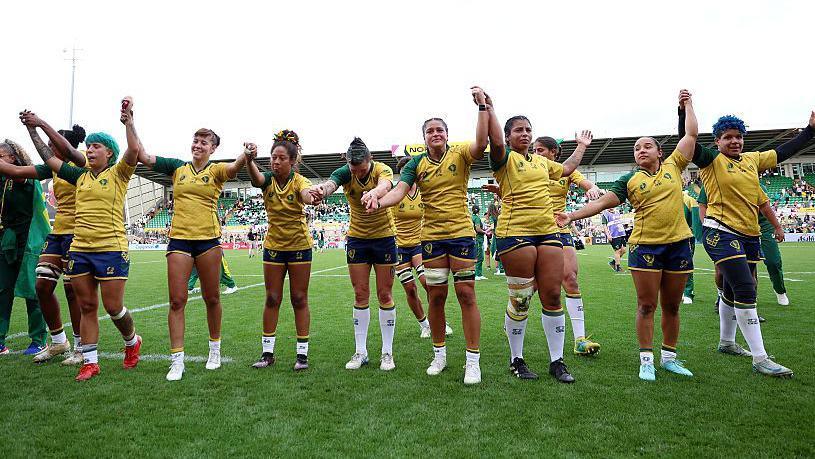
Fly Half Raquel Kochann would go on to score the teams first ever points in their clash against South Africa whilst Bianca Silva would go on to score their first and only try in their game against France.
2. Canadians Lock In Their Legacy
In Canadas second pool game, a 42-0 thrashing of Wales, Sophie de Goede kicked six conversions. Those points took her to the top of the Canadian Women’s point scoring list. De Goede finished the tournament having scored 298 points in her Canadian career, putting her fourth in the all time top Canadian points scorers3. She would also go on to be named World Player of the Year following the teams final loss to England at Twickenham.


De Goede’s second row partner Tyson Beukeboom made history in Canada’s final pool game against Scotland, gaining her 81st cap, becoming the most capped Canadian player of all time. Beukeboom finished the tournament on 84 caps.
3. Springbok Women Put the World on Notice
With their win over Brazil, South Africa recorded their first Rugby World Cup win since 2014. With their game over Italy a week later, they booked a place into their first ever Rugby World Cup Quarter Final. Whilst they fell short to France in their final pool stage game, and suffered a second half hammering against New Zealand4, South Africa showed the world what they are currently capable of. With subsequent reports of heavy investment into the women’s game and the establishment of EPD u16’s squads for girls5, it looks like they will continue to climb up the World Rankings and soon upset yet more of the world’s top nations.

Byrhandré Dolf also booked herself into the history books. Scoring 27 points across 4 World Cup games during a singular tournament, Dolf became the top South African Women’s World Cup points scorer in history. The top spot was previously held by Zandile Nojoko, who had scored 26 points across 15 matches in three tournaments.
4. New Zealand v England Canada v England Final: A ‘Shock’ New Zealand Loss
In what was expected to be a hotly contested semi-final, Canada stormed ahead to a 34-19 win against New Zealand, conceding their first penalty in the final quarter of the game. This gave the Black Ferns their third ever Rugby World Cup loss, alongside a semi-final loss against the USA in 1991 and a shock pool stage defeat by Ireland in 2014. The Black Ferns would go on to win the Bronze final.

5. The Final.
Days before the final it became known that Asia Hogan-Rochester would be the first openly genderfluid player in a Rugby World Cup Final6 and the history making did not stop there. Firstly, Hannah Botterman won the World Cup with England, 31 years after her aunt, Jane Everitt, won the World Cup with England. Both women even play in the front row, although Everitt preferred tighthead over Botterman’s preference of loosehead7. Scottish referee Hollie Davidson also became the first ever referee to take charge of two Women’s Rugby World Cup Finals8.

The final itself set records. With 82,000 tickets sold, the eventual attendance figure was 81,8559, the second largest Rugby World Cup final attendance behind the 2003 Men’s Rugby World Cup Final. It also became the highest attended women’s rugby match of all time, beating the previous record of 66,000 set at the 2024 Olympics or the standalone record of 58,498 set at Twickenham during the 2023 Women’s Six Nations. The twenty point deficit is also tied for the third largest points difference in Rugby World Cup final history10.
A More Personal Note
I was extremely lucky to be able to travel around England and attend many matches across the competition. Whilst I am now extremely tired and frankly a bit broke11, I felt that this was potentially a once in a lifetime experience. What started off as asking my dad for final tickets for Christmas last year turned into travelling to Northampton three times, Manchester and Bristol twice, and Exeter and London once each, designing custom tee shirts and handed out stickers to strangers who became friends. I’m incredibly thankful to have experienced a ‘home’ World Cup12 and to have been able to attend so many games.
I have so many personal highlights from the World Cup, including but not limited to meeting many of my favourite players (including blooming Pauline Bourdon-Sansus) and many of my internet pals. Also in a particularly strange turn of events, after the final the one and only Robbie from Squidge Rugby wore one of my Sophie de GOATe shirts on For The Love of Rugby. That was great. And very weird.
Whilst this is very different from my usual type of content, and I am sure I have missed out on a few bits and pieces, I thought it would be nice to get something out whilst I carry on researching behind the scenes. I would like to thank everyone who has subscribed to the new site, everyone who has discovered the project during the World Cup and everyone who has been around for a while!
-Hattie
Thanks for reading The Rugby History Project! Subscribe for free to receive new posts, or consider upgrading to Historian Tier to support the project!
- As of 2025 those nations are: The Netherlands, Sweden, Kazakhstan, Germany, Hong Kong China and Brazil ↩︎
- Sudamérica Rugby, “Brasil Clasificó a La Rugby World Cup Femenina 2025 | Sudamérica Rugby,” Sudamérica Rugby <https://www.sudamerica.rugby/espanol/brasil-clasifico-a-la-rugby-world-cup-femenina-2025-3?nid=1087>. ↩︎
- Behind James Pritchard (607), Gareth Rees (491), and Bobby Ross (419). De Goede is also the top points scoring Canadian forward. ↩︎
- Despite going in equal at half time. ↩︎
- “Landmark EPD Squads for U16 Boys and Girls Confirmed,” SA Rugby, September 15, 2025 <https://www.springboks.rugby/news-features/articles/2025/09/15/landmark-epd-squads-for-u16-boys-and-girls-confirmed/>. ↩︎
- I believe that Squige Rugby was the first to discover this. ↩︎
- Murshida Uddin, “Rugby’s Family Fortunes: From a Hollywood Movie Star Dad to a World-Cup Winning Auntie,” The Guardian, August 18, 2025 <https://www.theguardian.com/sport/2025/aug/18/rugby-union-womens-world-cup-familly-connections>. ↩︎
- André Watson of South Africa previously refereed the 1999 and 2003 Men’s Rugby World Cup Finals. ↩︎
- Presumably some corporate tickets didn’t turn up as anyone else would’ve tried to sell their tickets to the hottest seat in town. ↩︎
- The twenty point difference shares third place with the 1987 and 2019 Men’s World Cup Finals, whilst the 1999 Men’s World Cup Final resulted in a 23 point difference and the 1998 Women’s World Cup Final came out with a huge 32 point difference. ↩︎
- Thank you to the lovely British train network. ↩︎
- I’m a Wales fan but live in England. ↩︎
 Home
Home 
Leave a comment